
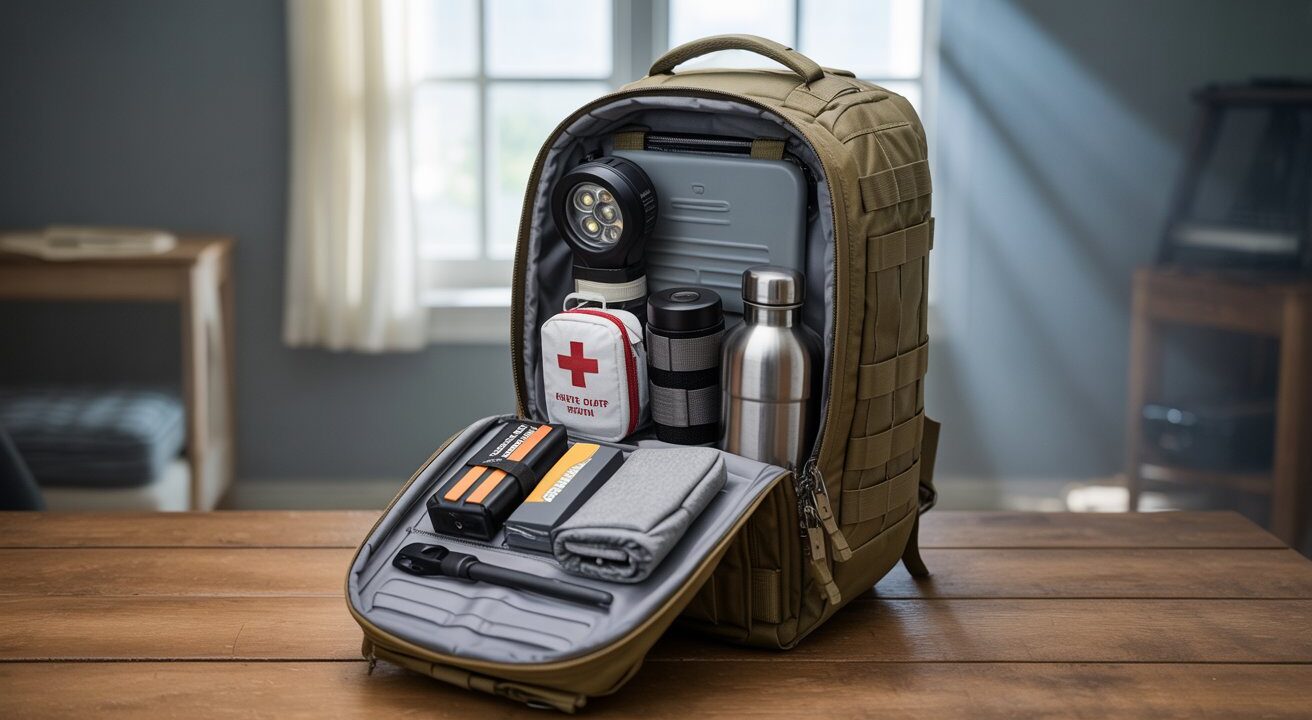
A go bag is built around one premise: if you need to leave quickly and move under uncertainty, everything in that bag needs to earn its place. Weight matters. Accessibility matters. Every item is evaluated against the question of whether it contributes to getting you out of a bad situation safely.
Ballistic protection belongs in that conversation, but it needs to survive the same scrutiny as everything else in the bag.
The Go-Bag Context Changes the Evaluation
Backpack armor for a school bag or daily commute is evaluated primarily on certification, fit, and weight for a sedentary or low-activity carry environment. A go-bag scenario is different in several important ways.
You may be moving over distance, potentially for hours. The bag will be worn actively, not carried casually. The threat environment in a genuine emergency or civil unrest scenario may include both handgun and rifle risks. And critically, the armor needs to function as part of a broader loadout, not as a standalone purchase evaluated in isolation.
Those differences point toward a more deliberate specification process than a standard backpack insert purchase requires.
Hard Insert vs. Soft Armor Panel: The Go-Bag Trade-Off
For most backpack insert applications, NIJ Level IIIA soft armor is the practical default. For a go-bag, the question deserves more consideration because the threat environment that justifies a go-bag in the first place may be more serious than a standard daily carry scenario.
Soft armor inserts (Level IIIA) remain the lighter, more packable option. A quality UHMWPE-based Level IIIA panel at 10×12 inches runs approximately 1.0 to 1.5 pounds. It covers handgun threats reliably across the full rating spectrum and adds minimal weight to a bag that’s already carrying survival essentials. For most civilian emergency preparedness contexts, this is the realistic and appropriate choice.
Hard plate inserts (Level III or Level III+) address rifle-caliber threats on the covered area. A standalone Level III UHMWPE hard plate runs between 3 and 5 pounds depending on construction and dimensions. Ceramic composite plates at Level III run heavier still. The weight addition to a go-bag that may already be carrying 20 to 30 pounds of gear is significant and needs to be justified by an honest threat assessment, not a worst-case assumption.
The middle-ground option worth evaluating is a thin, standalone Level III UHMWPE plate rather than ceramic. UHMWPE composite plates at Level III offer rifle protection at substantially reduced weight compared to ceramic, making the go-bag weight calculation more manageable for buyers who’ve determined rifle-level protection is warranted. The full range of plate construction options across body armor formats is worth reviewing when making that trade-off decision.
Placement and Accessibility in the Bag
A backpack insert protects what it sits behind when the bag is being worn with the threat approaching from the rear. In a movement scenario, that coverage zone is meaningful. In a scenario where you’ve set the bag down or are facing a threat from another direction, the insert’s protective function is limited to its actual coverage position.
Most quality go-bags include a dedicated back panel sleeve, a padded compartment against the back of the bag closest to the wearer. That’s the correct location for a ballistic insert. It positions the panel directly against the wearer’s back and maintains coverage during wear. An insert floating loose in the main compartment among other gear is not reliably positioned and may not perform as intended.
If your current go-bag doesn’t have a dedicated back sleeve, evaluate whether the main compartment geometry allows the panel to sit stably flat against the rear panel during wear. If it doesn’t, it’s worth either modifying the bag’s organization or evaluating a bag designed with armor integration in mind.
Weight Budget: Armor in the Context of the Full Loadout
This is the calculation most go-bag armor discussions skip, and it’s the most practically important one.
A realistic go-bag loadout including water, food for 72 hours, first aid, communication, navigation, and essential tools commonly runs between 20 and 35 pounds depending on configuration. Adding a Level IIIA soft panel adds roughly 1.5 pounds. Adding a Level III hard plate adds 3 to 6 pounds. Adding both a hard plate in the bag and separate soft armor worn on the body adds the full combined weight to what you’re moving with.
At Arctos, the conversation we have with buyers building out emergency preparedness loadouts is always about total system weight, not individual component specifications. A 40-pound go-bag that includes the best possible armor insert is less useful over a 10-mile movement than a 28-pound bag with appropriate but lighter protection that you can actually sustain.
Be honest about your realistic movement capacity under load before finalizing the specification.
Integration With Worn Armor
One consideration that rarely appears in backpack insert content is how the insert relates to any armor you’re wearing on your body.
If your go-bag preparedness plan includes wearing a plate carrier or soft armor vest during deployment, the backpack insert provides supplemental rear coverage in addition to what the carrier is already providing. In that configuration, the insert redundancy may be less critical, and a lighter Level IIIA soft panel in the bag is a reasonable addition without significantly impacting the weight budget.
If the backpack insert is your only ballistic protection in a go-bag deployment scenario, and you’re not wearing a separate vest or carrier, then the insert becomes your primary protection layer. That shifts the specification conversation toward a more carefully evaluated panel choice, including considering whether rear-only coverage is sufficient for the specific scenario you’re preparing for.
What to Prioritize
For a go-bag ballistic insert, the evaluation hierarchy looks like this:
- NIJ Certified at the appropriate level, verified on the NIJ Compliant Products List before purchasing
- Weight evaluated against your total loadout budget and realistic movement requirements
- Panel dimensions confirmed to fit your specific bag’s back sleeve flat and flush
- Material construction with UHMWPE preferred for the best weight-to-protection ratio at both Level IIIA and Level III
- Integration with any worn armor you’re including in the same deployment plan
The insert that earns its place in a well-built go-bag is the one that provides verified protection at a weight your loadout can absorb without degrading your ability to move effectively when it counts.
If you’re building out a go-bag setup and want to talk through the armor component specifically, the team at Arctos is glad to help.
Is this a solo loadout or are you configuring for multiple people? That changes the procurement conversation considerably.