
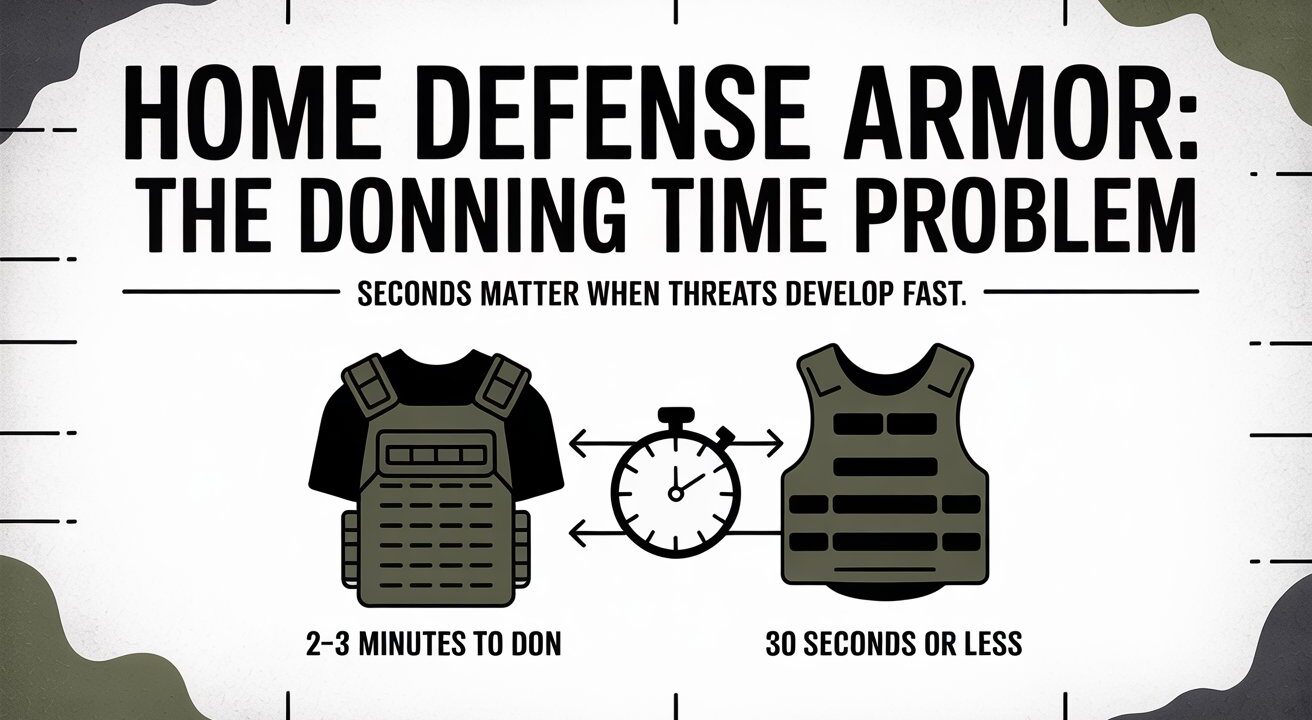
Here’s a question most armor content skips entirely: in a home defense scenario, how much time do you have to put your armor on?
The answer to that question should drive most of your purchasing decision, and it rules out a significant portion of what gets marketed as “home defense armor” based on appearance alone.
The Donning Time Problem
A home invasion scenario develops fast. The realistic window between a threat presenting and needing to act is measured in seconds, not minutes. A full plate carrier with cummerbund buckles, shoulder strap adjustments, and side plate integration can take two to three minutes to don correctly under calm conditions. Under stress, in low light, that number goes up.
This doesn’t make plate carriers irrelevant for home defense. It means that any armor solution for this context needs to be evaluated against the question of whether you can realistically get it on before you need it. A vest that’s accessible, simple to put on quickly, and fits without adjustment is more valuable in this scenario than a technically superior system that stays in the closet because it’s too involved to deploy under pressure.
What Threat Level Is Actually Appropriate
The honest answer for most home defense contexts is that NIJ Level IIIA soft armor covers the realistic threat profile well.
The majority of criminal home invasion threats in the United States involve handguns. Level IIIA is tested against a broad range of handgun calibers including higher-velocity 9mm and .44 Magnum, covers the threat category you’re most likely to face, and comes in soft armor formats that are significantly lighter and faster to put on than hard plate systems.
Hard plates rated to Level III or Level IV address rifle threats. If your specific situation includes a realistic rifle threat in a home defense context, that changes the calculus. For most residential scenarios, adding rifle plate weight and donning complexity to a handgun-threat environment is over-specification that works against the practical usability of the equipment.
Format: What to Actually Look For
For home defense specifically, the most practical soft armor formats are:
Quick-don vests with simple closure systems. Look for carriers that use wide hook-and-loop (Velcro) side closures or simple buckle systems rather than complex plate carrier rigging. These can realistically be donned in under 20 seconds with practice.
Correct panel sizing for your torso. A vest that fits well doesn’t require adjustment at deployment. Buying the wrong size and planning to “make it work” in an emergency is not a realistic plan. Confirm panel dimensions and carrier sizing match your actual measurements before purchasing.
Accessible storage. Where the vest lives in your home matters as much as the spec. A vest stored in an accessible location near your defensive firearm is deployed. A vest in a case at the back of a closet is not.
Some homeowners choose a purpose-built quick-don carrier stored next to a nightstand or in a dedicated location alongside their home defense firearm. That integration between the armor and the broader home defense setup is worth thinking through before purchase rather than after.
Soft Armor Certification: Same Rules Apply
The civilian home defense market attracts a range of products at varying price points, and certification discipline matters here exactly as it does in any other armor purchase.
Verify the specific product on the NIJ Compliant Products List at nij.gov before buying. NIJ Certified means independent third-party laboratory testing. “Meets NIJ standards” without that listing means significantly less. A vest that doesn’t perform to its rated level in the moment you need it is worse than a straightforward outcome because it created false confidence in the preparation.
Pricing context: a quality NIJ-certified Level IIIA soft armor panel in a quick-don civilian carrier typically runs between $300 and $600. Products significantly below that range warrant close scrutiny of their certification documentation.
Do You Need a Plate Carrier for Home Defense
The short answer is: rarely, and only if the specific threat environment justifies it.
A plate carrier with Level III or Level IV plates is appropriate when rifle-caliber threats are a realistic part of your home defense threat assessment, and when you’ve considered the donning time problem honestly. Some homeowners in rural or elevated-risk environments maintain a plate carrier as part of a more comprehensive preparedness setup, with the understanding that it’s deployed in scenarios that allow more preparation time, not for immediate response to a rapid-developing threat.
If you’re considering a plate carrier for home defense, a low-profile carrier with simple strap geometry and quick-adjust shoulder systems reduces donning time compared to full tactical carriers. The body armor options across soft armor and plate carrier formats are worth reviewing in the context of your specific preparedness picture.
A Practical Home Defense Armor Checklist
- NIJ Level IIIA soft armor covers the realistic handgun threat profile for most residential scenarios
- Quick-don carrier format with simple closure system is more practically useful than a complex tactical carrier
- Correct fit confirmed before purchase, not adjusted at deployment
- NIJ Certified verification on the NIJ Compliant Products List, not just marketing claims
- Accessible storage integrated into your home defense setup
- Service life awareness: note the manufacturing date and plan for replacement around the five-year mark
The right home defense armor is the one you can actually get on in time, that covers the realistic threat, and that you’ve verified performs to its rated level. Those three criteria narrow the field considerably and produce a more useful purchase than chasing the highest specification available.
If you want to talk through options for your specific situation, the team at Arctos is glad to help.
Is this for personal use or are you evaluating options for multiple household members? That affects the sizing and format conversation.