
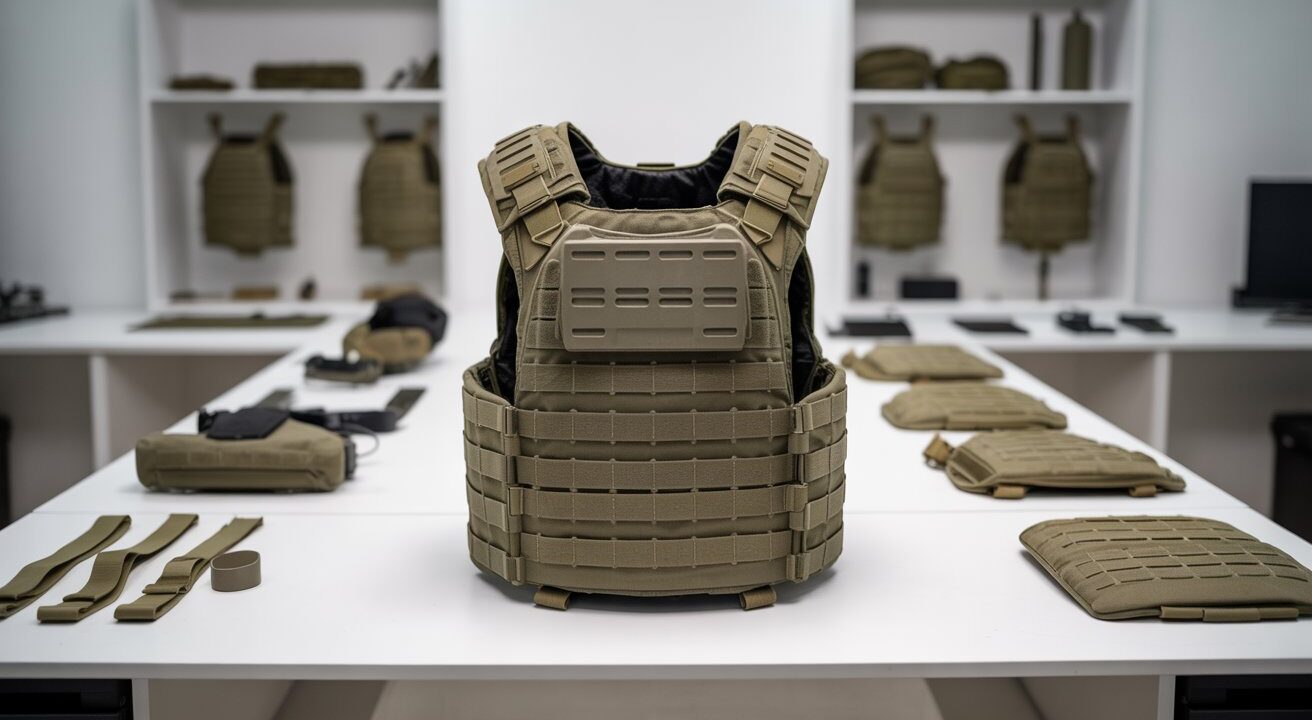
The Interceptor Body Armor system carries a specific kind of credibility among veterans and military professionals. For many people who served during the conflicts of the 2000s and early 2010s, it’s the baseline reference point for how body armor should fit, feel, and configure. That familiarity is understandable, and it’s also where some of the most persistent misconceptions about plate compatibility and protection begin.
For Law Enforcement and Military professionals: your agency’s training officers and SOPs should guide your specific setup and employment. This article focuses on gear specifications and considerations to inform purchasing decisions.
The IBA System in Context
The Interceptor Body Armor system consists of an Outer Tactical Vest (OTV) made of Kevlar, designed to stop fragmentation and handgun rounds up to 9mm, combined with hard armor inserts that provide rifle-level protection. The vest itself is not the ballistic protection against rifle threats. The plates are.
The IBA has been largely phased out of active U.S. military service, replaced by the Improved Outer Tactical Vest (IOTV) and subsequent plate carrier systems. However, a significant number of veterans own IBA systems, and surplus units appear regularly in legitimate secondary markets. Understanding what plates actually work with that system, and what the trade-offs look like, remains a practical question for that population.
SAPI vs. ESAPI: The Distinction That Matters Most
This is where most compatibility confusion originates, and it’s worth being precise.
SAPI (Small Arms Protective Insert) plates are the original inserts designed for the IBA system, tested to military protocols against 7.62 NATO M80 ball at standard velocity. They are broadly equivalent to NIJ Level III protection. The name is now used more to describe a plate cut and geometry than a protection level.
ESAPI (Enhanced Small Arms Protective Insert) plates were introduced by the U.S. military beginning around 2005, replacing SAPI in active service. ESAPI plates are engineered to NIJ Level IV-equivalent specifications, tested against .30-06 M2 AP armor-piercing rounds. They fit the same plate pockets as SAPI plates in the IBA system but provide meaningfully higher protection.hardshell+1
The practical implication: if you have an IBA vest and want Level IV protection, you need ESAPI-specification plates, not SAPI plates. The plate pockets accommodate both, but the protection levels are not equivalent.
The Sizing Complication
Here is where IBA compatibility gets genuinely technical, and where commercial plate purchases for IBA systems can go wrong.
Military SAPI and ESAPI plates follow specific dimensional standards that differ slightly from commercial plate dimensions. A military medium SAPI plate measures 9.5 x 12.5 inches. A commercial “medium” plate is typically manufactured at 10 x 12 inches. That half-inch width difference means a commercial 10×12 plate will fit tightly across the width of an IBA medium plate pocket and may leave gap space above and below.
The size breakdown for military ESAPI plates is:
| Size | Dimensions | Weight |
| Extra Small | 7.25″ x 11.5″ | ~3.5 lbs |
| Small | 8.75″ x 11.75″ | ~5.0 lbs |
| Medium | 9.5″ x 12.5″ | ~6.0 lbs |
| Large | 10.25″ x 13.25″ | ~6.9 lbs |
| Extra Large | 11.0″ x 14.0″ | ~7.2 lbs |
When purchasing commercial plates for an IBA system, confirm that the plate dimensions match the specific IBA plate pocket you’re working with, not just the general size designation. Several commercial manufacturers produce plates in ESAPI-matched dimensions specifically for this reason. Requesting the exact dimensional specifications from any supplier before purchasing is the step that prevents a compatibility problem discovered after delivery.
ICW vs. Standalone: A Critical Specification
Commercial ESAPI-format plates are sold in two configurations that directly affect how they interact with the IBA vest.
ICW (In Conjunction With) plates are designed to be worn in conjunction with a Level IIIA soft armor backing, which the IBA Kevlar vest provides. The plate and the vest work as a combined system, and the plate’s certified protection level assumes the soft armor is present underneath. ICW plates are generally lighter because the vest is doing part of the protective work.
Standalone (STA) plates provide their full rated protection independent of any soft armor backing. They’re heavier than equivalent ICW plates but function correctly whether or not a soft armor base layer is present.
For IBA users, ICW plates are the technically correct configuration, since the IBA Kevlar vest provides the IIIA-equivalent base layer the ICW designation requires. The weight savings compared to standalone plates is real, and for a system already running heavy, that matters. Verify that any commercial plate purchased for IBA use specifies its ICW or standalone configuration and that it matches your intended use.
The Weight Reality of IBA with Level IV Plates
The IBA OTV is a heavier vest platform than modern plate carriers. The Kevlar vest itself adds approximately 8 pounds before any plates are inserted. Adding a pair of ESAPI-format Level IV ceramic plates at 6 to 7 pounds each brings the total system to 22 to 24 pounds for front and rear plates alone, before side plates, accessories, or any additional load.
That weight is the primary practical limitation of running Level IV protection in the IBA platform, and it’s why modern military procurement moved toward lighter carrier systems with more efficient weight distribution. For veterans using IBA as a familiar, accessible platform, understanding that weight reality is important for any extended wear scenario.
UHMWPE composite plates at Level III with supplemental testing against M193 and M855, what the market calls Level III+, offer a meaningful weight reduction compared to ceramic ESAPI plates and fit IBA plate pockets in the same SAPI cut format. For users whose threat environment doesn’t specifically include M2 AP armor-piercing rounds, that trade-off is worth evaluating honestly. The full range of body armor plate options across ceramic and UHMWPE constructions is worth reviewing in that context.
Practical Guidance for IBA Plate Purchases
Before purchasing Level IV plates for an IBA system:
- Confirm whether you need SAPI-cut or ESAPI-cut plates, understanding that ESAPI-cut commercial plates match the IBA pocket geometry better than standard shooter’s cut commercial plates
- Measure your specific IBA plate pocket dimensions and cross-reference against the commercial plate’s exact dimensional specifications, not just its size label
- Determine ICW or standalone based on whether you’re wearing the IBA Kevlar vest as the base layer
- Verify NIJ certification or third-party test documentation for the specific plate model, not just the brand
- Factor total system weight against your realistic wear requirements before committing to Level IV ceramic over lighter alternatives
The IBA is a proven system with a legitimate service history. Running quality Level IV protection in it is achievable with the right plate selection. The compatibility details are what make the difference between a well-sourced setup and a purchase that creates problems after delivery.
If you’re sourcing plates for an IBA system and want to work through the compatibility and specification questions directly, the team at Arctos is glad to help.
What size IBA vest are you working with? That’s typically the first question that shapes the plate sourcing conversation.