
Picture this: a firearm goes missing from your department’s storage room. Not stolen in a break-in. Just… unaccounted for. No log entry. No sign-out record. No idea when it was last seen.
That scenario plays out in police departments across the country, and the fallout isn’t just embarrassing. It can be catastrophic, legally and financially.
Weapons storage often gets treated as a facilities issue. Buy some gun racks, lock the room, done. But that thinking leaves departments exposed in ways that don’t become obvious until something goes wrong.
Here’s what I’ve seen working with law enforcement agencies: the departments with the worst storage practices aren’t reckless. They’re just working with systems that haven’t kept up with the accountability standards now expected of them.
Audits Don’t Warn You Before They Arrive
State audits, DOJ compliance reviews, accreditation inspections — they all touch weapons storage. The agencies that scramble to get their paperwork in order the week before an audit tend to find out, too late, that a log book and a padlock don’t constitute a compliant system.
What auditors want is a clear, documented chain of custody for every firearm in your inventory. Which officer checked out which weapon, when, for what purpose, and when it came back. If your system can’t answer those questions quickly and accurately, you have a problem even if nothing has actually gone missing.
Failed audits have real consequences: loss of accreditation, federal funding restrictions, forced remediation plans, and the kind of public scrutiny that makes everyone’s job harder.
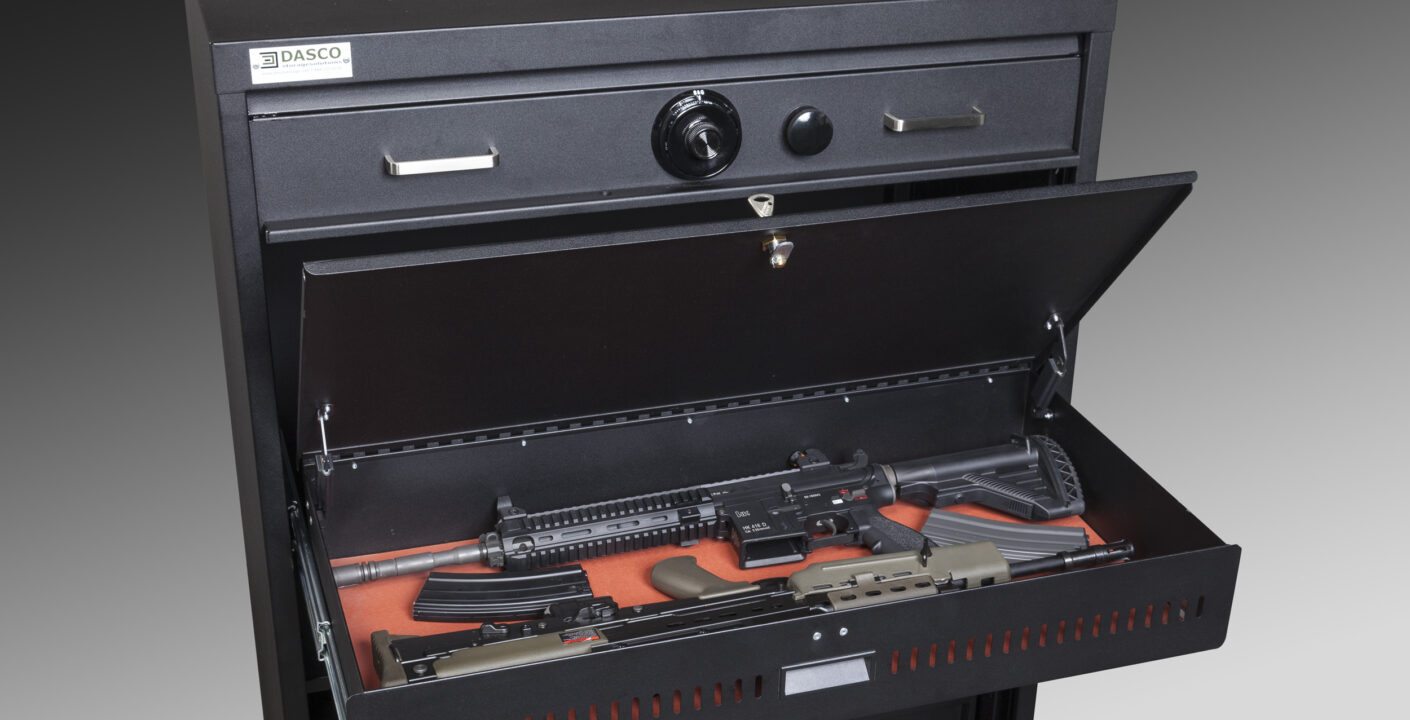
To understand what compliant law enforcement weapons storage actually looks like, explore DASCO’s law enforcement weapons storage solutions.
Missing Firearms and the Lawsuits That Follow
There’s a legal theory called negligent entrustment. Simplified: if your department allows a firearm to end up in the wrong hands because of inadequate oversight, and that weapon is later used to harm someone, you can be held liable.
This isn’t a fringe concern. Several departments have faced civil suits after unaccounted-for duty weapons turned up connected to criminal incidents. In some of those cases, the departments couldn’t produce chain-of-custody records showing where the firearm had been or who had accessed it.
That absence of documentation didn’t just complicate the legal defense. In some cases it became the central issue.
Secure, trackable storage isn’t just about keeping firearms where they belong. It’s about being able to prove it.
The Evidence Storage Problem Is Separate But Just as Serious
Weapons that come in as evidence operate under a completely different set of rules than duty firearms, but the documentation requirements are even more demanding. Chain of custody for evidence weapons can determine whether a prosecution succeeds or collapses.
Departments that mix evidence storage with general storage, or that rely on manual logs to track high volumes of evidence items, are creating conditions where something will eventually slip through. And “eventually” tends to happen at the worst possible time, usually mid-trial.
I’ve spoken with evidence custodians managing hundreds of items across a system built for a fraction of that volume. They’re doing the best they can, but they know they’re one audit or one contested chain-of-custody away from a serious problem.
See how purpose-built DASCO evidence storage systems address chain-of-custody demands from the ground up.
What Actually Changes When You Fix the System
Departments that move to purpose-built, tracked storage consistently report the same things: less time spent on manual reconciliation, faster audit responses, and a reduction in the low-level chaos that comes with systems nobody fully trusts.
The right storage solution does a few specific things well. It restricts access at the individual level, so you know exactly who opened what and when. It creates automatic logs that don’t depend on someone remembering to sign out. And it integrates with your existing records management instead of adding another separate process.
For evidence weapons specifically, the chain of custody should be built into the storage system itself, not reconstructed from paper logs after the fact.
Browse the full Arctos Industries equipment catalog and see how we source gear built around real accountability requirements.
This Isn’t a Budget Question. It’s a Risk Calculation.
I understand the budget conversation. Every department has competing priorities, and storage upgrades rarely make it to the top of the list on their own.
But consider the cost-benefit honestly. One civil lawsuit tied to an unaccounted firearm will cost more than a full storage system upgrade. One failed accreditation review triggers a remediation process that costs staff time, legal exposure, and public trust.
The departments I’ve seen make the internal argument for better storage aren’t doing it because someone mandated it. They’re doing it because someone sat down and calculated what “good enough” actually costs when something goes wrong.
What’s your department’s current system built around? Manual logs, key access, or something more accountable? Worth asking before someone else asks it for you.
Read more guides like this on the Arctos Industries blog.
Want to talk through your department’s specific situation?
Every department’s storage challenges are a little different — budget constraints, facility limitations, evidence volume, number of officers. We’ll help you work out what a compliant, trackable system actually looks like for your setup.
Reach out to the Arctos team at arctosindustries.com/contact or explore everything we offer at arctosindustries.com.
For Law Enforcement professionals: your agency’s training officers and SOPs should guide your specific operational setup. This article focuses on storage specifications and accountability considerations to inform purchasing and compliance decisions.