
A chain-of-custody system is only as strong as its weakest handoff point. Most evidence rooms have several.
This guide is written for evidence technicians and the supervisors who support them. Not for administrators looking for a policy document to file away, but for the people who actually manage intake, track items through storage, prepare evidence for court, and sign off on disposals. The people who know exactly where their current system has gaps because they work around those gaps every single day.
For Law Enforcement professionals: your agency’s training officers and SOPs should guide your specific operational setup. This article focuses on storage specifications and evidence management considerations to inform purchasing and process decisions.
Intake: Where Most Chains Break
The intake stage is where chain-of-custody failures most commonly originate, not because evidence technicians are careless, but because intake is high-volume, often time-pressured, and dependent on information coming in from officers who are focused on the arrest, not the paperwork.
A solid intake process does three things consistently. It assigns a unique identifier to every item the moment it enters the system. It records who submitted it, who received it, the date and time, and the condition of the item at intake. And it generates a record that neither party can later modify unilaterally.
The last point is where paper-based systems fall apart. A manual log can be amended, misread, or lost. An intake entry in a digital evidence management system creates a timestamped record that is significantly harder to challenge in court.
Practically speaking, your intake area should be physically separated from general storage. Items should never move directly from an officer’s hands to a shared storage space without passing through a documented intake step. If your current layout doesn’t enforce that separation physically, it’s worth addressing at the facility level.
Storage Assignment: Zoning Your Evidence Room
Not all evidence is the same, and your storage layout should reflect that. Firearms require different storage conditions than narcotics, biological evidence, or digital media. Mixing categories in a shared space without physical separation creates access control problems and complicates your audit trail.
A practical zoning approach for evidence firearms looks like this:
Primary firearms storage: Access-controlled, individually logged, restricted to authorized evidence personnel only. This is where seized weapons live from intake until disposition or court transfer.
Temporary holding: A secure but accessible staging area for items actively being processed, photographed, or prepared for transfer. Items should never stay here longer than one shift without being logged into primary storage.
Court transfer staging: A designated area for items that have been pulled for court appearances, with a corresponding log entry showing they’ve left primary storage, who pulled them, when, and for which case.
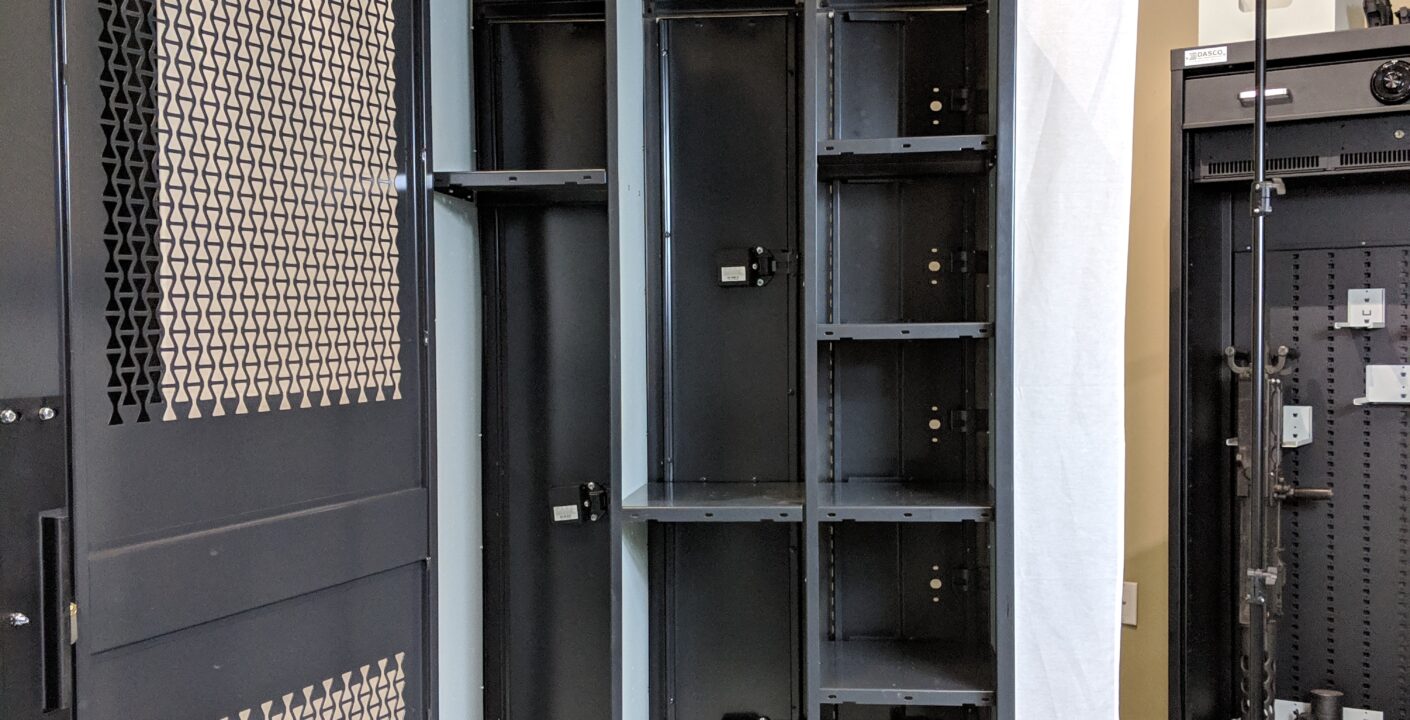
The physical infrastructure supporting this zoning matters as much as the policy. Storage units with individual access control, automatic logging, and tamper-resistant construction remove the human consistency requirement from your chain-of-custody. DASCO’s evidence storage systems are built around exactly this kind of zoned, access-controlled approach, with audit trail functionality that integrates with existing records management systems.
The Transfer Log: Every Handoff Documented
Every time an evidence item changes hands, that transfer needs a record. This sounds obvious. In practice, it’s the step most frequently skipped under time pressure, and skipped transfers are exactly what defense counsel goes looking for.
Your transfer SOP should require documentation for every movement of a firearm out of primary storage, including internal transfers between evidence personnel, transfers to the lab, transfers to the range for test firing, transfers to court, and returns from any of the above.
Each transfer entry should capture: the item identifier, the name of the person releasing custody, the name of the person accepting custody, the date and time, the purpose of the transfer, and the expected return date where applicable.
If your current system makes this documentation feel burdensome, that’s a systems problem, not a personnel problem. A well-configured digital evidence management system makes transfer logging take seconds, not minutes, and it creates records that don’t depend on anyone’s handwriting being legible six months later.
Ammunition Storage: A Separate Accountability Track
Ammunition seized as evidence operates under the same chain-of-custody requirements as firearms, but it’s frequently managed less rigorously because it feels like a lower-stakes item. That assumption creates gaps.
Ammunition lots need individual identifiers, storage separate from non-evidence ammunition, and the same transfer logging requirements as firearms. If seized ammunition is being stored in the same location as departmental ammunition supply without clear physical and documentary separation, you have a chain-of-custody vulnerability that will surface during any serious audit.
Dedicated ammunition storage solutions designed for evidence environments maintain that separation by default, with storage configurations that make commingling physically impossible rather than just procedurally discouraged.
Court Preparation: The Handoff That Gets Scrutinized Most
By the time evidence reaches court, it has typically passed through multiple hands over months or years. Defense counsel knows this, and their job is to find any gap in that journey they can use.
Your court preparation SOP should work backward from the question a defense attorney will ask: can you account for the location and condition of this item at every point between seizure and this courtroom?
Practically, this means your court transfer documentation should include a condition check at the point of release from evidence storage, a comparison against the condition recorded at intake, and a clear record of every person who handled the item in between. If the item was test-fired, sent to a lab, or temporarily stored at a secondary facility, each of those events needs its own documentation.
The evidence technician preparing items for court should be able to print or export a complete chain-of-custody report directly from the evidence management system. If that report requires manual compilation from multiple sources, it will eventually have a gap.
Disposition and Destruction: Closing the Loop
Evidence that reaches the end of its lifecycle, whether through case closure, court order, or destruction mandate, needs the same documentation discipline as every other stage. Disposition records that are incomplete or missing create audit vulnerabilities even for items that are no longer in your possession.
Your disposition SOP should require documented authorization from the appropriate authority before any firearm leaves the evidence system permanently, a record of the method of disposition, and a final chain-of-custody entry that formally closes the item’s record.
For departments that destroy evidence firearms, documentation of the destruction process itself, including who witnessed it and how it was carried out, should be retained as part of the permanent record.
The System Behind the SOP
Every SOP in this guide depends on infrastructure that can actually support it. Manual systems can document these procedures on paper, but paper doesn’t enforce consistency, doesn’t generate automatic audit trails, and doesn’t integrate with the records management systems prosecutors rely on.
The departments with the strongest chain-of-custody records aren’t necessarily the ones with the best-written policies. They’re the ones whose storage infrastructure makes following the policy the path of least resistance, because the system logs the action automatically whether or not the technician remembers to.
That’s the standard worth building toward. Read more practical guidance for law enforcement evidence management on the Arctos Industries blog.
Want to evaluate whether your current evidence storage infrastructure supports the chain-of-custody standard your department needs?
We work with evidence technicians and department leadership to identify gaps and match storage solutions to real operational requirements. Practical conversation, no pressure.
Reach out at arctosindustries.com/contact or visit arctosindustries.com to learn more.