
The sergeant who reached out to us didn’t use the word “crisis.” He used the word “embarrassing.”
His department’s gear room had been a known problem for years. Everyone who worked there knew it. New officers figured it out within their first week. Leadership had talked about fixing it through two budget cycles without it making the final cut. It wasn’t broken enough to be urgent. It was just bad enough to be a constant, low-grade drain on every shift that used it.
What changed wasn’t the budget. What changed was that someone finally sat down and calculated what the current situation was actually costing, and the number was harder to ignore than the problem had been.
What They Were Working With
The department ran three shifts across a facility built for roughly half its current headcount. The gear room had expanded informally over the years as equipment inventory grew, with shelving added where space allowed, shared cabinets pushed against whatever wall had room, and individual officers staking informal claims to specific hooks, shelves, and floor space that everyone respected but nobody had officially assigned.
It worked, in the way that improvised systems work: adequately most of the time, badly under any kind of pressure. During a normal shift transition it was slow and frustrating. During a callout or a rapid deployment, it was genuinely problematic. Officers spent time they didn’t have locating equipment that should have been immediately accessible, and the debrief after more than one incident included some version of “we lost two minutes in the gear room.”
Two minutes doesn’t sound like much. In the contexts where it was happening, it was.
The accountability picture was equally uncomfortable. Shared storage with no individual assignment meant that when equipment went missing or came back damaged, the trail went cold almost immediately. The department couldn’t say with confidence who had used what or when. Inventory reconciliation before inspections was a multi-hour exercise in manual counting and educated guessing.
The Assessment Before the Solution
The first thing we did wasn’t propose a system. It was ask questions.
How many officers share the space across all shifts? What categories of equipment are being stored and in what volumes? Where does the friction actually occur — intake, location, retrieval, return? What does a shift transition look like at its worst? What does the inspection and accountability process currently require, and how long does it take?
That conversation produced a clearer picture than the department had previously articulated, partly because nobody had asked the questions systematically before. The gear room problem had been experienced as a general frustration rather than a set of specific, addressable failures.
What emerged was a fairly consistent set of root causes. Individual assignment didn’t exist in any meaningful way, so nothing had a home that was reliably its own. The layout hadn’t been designed around the actual equipment inventory, so high-frequency items weren’t necessarily in accessible locations. There was no reset mechanism between shifts, so each shift inherited whatever state the previous one had left. And the storage infrastructure mixed categories that should have been separated, with personal gear, shared tactical equipment, and departmental assets all living in the same undifferentiated space.
What the Transformation Actually Involved
The physical upgrade centered on two things: individual assigned storage and categorical separation.
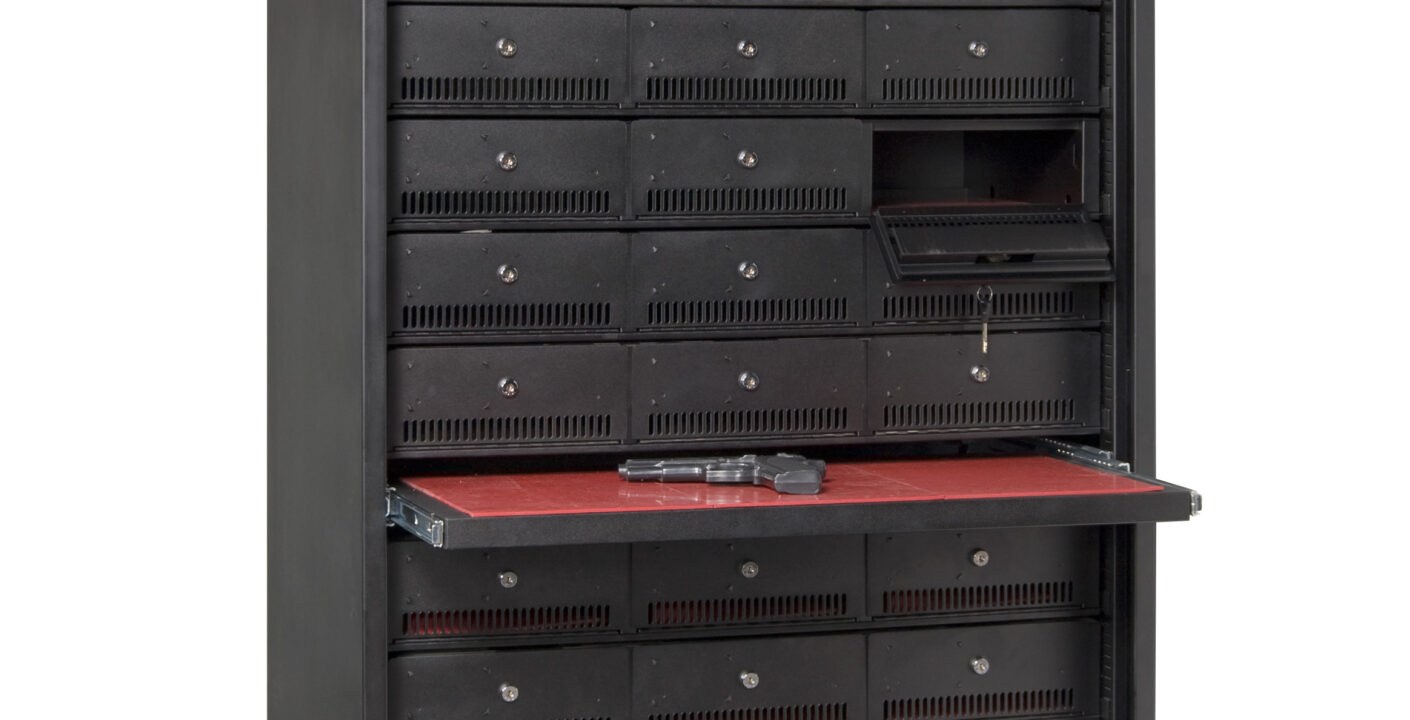
Every officer got a designated storage space for their personally assigned equipment. Not a shared cabinet with an informal claim, but a defined, labeled, access-controlled space that was theirs for their shift and reset to a known state when they left. The psychological effect of that change was something the sergeant mentioned specifically in follow-up conversations. Officers who had personalized gear, who carried equipment they’d configured themselves, who felt ownership over their kit, wanted a storage system that reflected that. The shared cabinet arrangement had always felt like a mismatch with how seriously most of them took their equipment.
DASCO’s law enforcement gear storage systems provided the individual assignment infrastructure, with configurations designed around the actual dimensions and access requirements of modern patrol and tactical equipment rather than generic storage dimensions that require officers to adapt their gear to the cabinet rather than the other way around.
Shared tactical equipment got its own designated space with access logging, separate from personal gear storage. High-frequency items were positioned for immediate access. Low-frequency items were stored further back with clear labeling. The layout reflected how the room actually got used rather than how it had accumulated over time.
For the corridor and transition spaces outside the main gear room, DASCO corridor lockers handled the overflow and staging requirements that a single-room solution couldn’t fully address, giving officers secure staging space for equipment being prepped for a shift or returned from one without that equipment ending up in the main storage area in a state that disrupted the reset process.
How Officers Reacted
Honestly, the initial reaction was mixed, which is worth saying because transformation stories that skip the skepticism aren’t useful to anyone planning a similar project.
Some officers were immediately positive. They’d been frustrated with the old system long enough that any improvement felt like a significant upgrade. Others were skeptical that a new cabinet arrangement would change much. A few were resistant to the individual assignment model because the informal system had worked well enough for them personally and they didn’t see why it needed to change.
What shifted the skeptics was time, not persuasion. Within a few weeks, the officers who had been most doubtful were the ones most vocal about the difference in their shift startup experience. Finding their equipment where they left it, in the condition they left it, without spending the first ten minutes of a shift sorting through a shared space, turned out to matter more than they’d expected it to.
The sergeant’s summary, about three months after the installation, was straightforward: officers who used to complain about the gear room had stopped complaining about the gear room. That’s not a dramatic outcome. It’s exactly what a well-designed storage system should produce.
What Changed on the Accountability Side
The operational experience was the visible change. The accountability improvement was less visible but arguably more significant for the department’s long-term interests.
Individual assignment created individual accountability by default. When equipment in a designated space went missing or came back damaged, the question of who was responsible had a starting point rather than an open field. That didn’t mean every discrepancy was immediately resolved, but it meant the investigation had traction rather than starting from nothing.
Inventory reconciliation before the next inspection took a fraction of the time it had previously required. The storage system maintained a consistent record of what was where and in whose assignment, so the pre-inspection process became a verification exercise rather than a reconstruction exercise.
The department’s inspection outcome reflected that. Not dramatically, not with commendations, but with the absence of the gear accountability findings that had appeared in previous reviews. The gear room stopped being a liability and started being a non-issue, which is exactly what it should be.
The Lesson That Applies Beyond This Department
The department in this story isn’t unusual. The combination of under-specified storage infrastructure, informally organized shared space, and accountability gaps that only become visible under pressure describes a significant number of gear rooms across the country.
What made the difference here wasn’t a particularly large budget or a uniquely complex problem. It was a willingness to assess the actual cost of the existing situation honestly, specify a solution around the real root causes rather than the surface symptoms, and commit to a reset that officers could actually use consistently.
If your gear room is generating the kind of friction described here, the question isn’t whether a better system exists. It does. The question is whether the cost of the current situation has become clear enough to act on. Read more practical guidance for law enforcement on the Arctos Industries blog.
Want to talk through what a gear room transformation looks like for your department’s specific layout and headcount?
We start with the assessment, not the sale. Tell us what you’re working with and we’ll help you figure out what actually needs to change.
Reach out at arctosindustries.com/contact or visit arctosindustries.com to learn more.
For Law Enforcement professionals: your agency’s training officers and SOPs should guide your specific operational setup. This article focuses on storage specifications and gear management considerations to inform purchasing decisions.