
The departments that perform best during external audits aren’t the ones with the most sophisticated storage systems. They’re the ones that already know what their systems produce, where the gaps are, and how to address them before anyone else starts asking questions.
That outcome comes from running your own review before the external one arrives. Not a cursory walkthrough the week before an inspection, but a systematic internal audit that applies the same scrutiny an external reviewer would, run by people who know your operation well enough to find problems that an outside reviewer might miss.
What follows is a practical checklist for that process, organized by storage category. It’s not a substitute for your accreditation body’s specific requirements, which you should review alongside this guide. It’s a starting framework that covers the areas where departments most consistently find problems, and where external reviewers most consistently look for them.
For Law Enforcement professionals: your agency’s training officers and SOPs should guide your specific operational setup and compliance requirements. This checklist focuses on storage specifications and documentation practices to support internal review processes.
Before You Start: Set the Audit Up Correctly
An internal audit that produces useful results needs a few structural elements in place before anyone opens a storage room door.
Assign a lead who isn’t the evidence custodian or armory supervisor being reviewed. Not because those individuals can’t be trusted, but because self-review has inherent blind spots. The person who built the current system and works within it daily is the least likely to notice what it normalizes. A supervisor from a different unit, or a peer from another department if your agency has that relationship, brings a more useful perspective.
Pull your current written policies for each storage category before the physical review. The audit is checking two things simultaneously: whether your policies meet the required standard, and whether your actual practice matches your policies. Both gaps create findings. Finding them internally means you can address them on your timeline rather than an auditor’s.
Document everything the audit produces, including what passed, not just what needs attention. A contemporaneous record of an internal audit that identified and addressed gaps is evidence of institutional diligence. It tells a story about a department that takes its accountability obligations seriously, which matters in any context where your storage practices come under scrutiny.
Weapons Storage Audit
Work through each of the following areas systematically. For each item, the question isn’t just whether the answer is yes or no, but whether you can prove it with documentation if asked.
Physical security. Verify the steel gauge specification of your weapons storage units against your accreditation body’s minimum requirements. Check door frame integrity, hinge condition, and lock function on every unit. Confirm that all units are anchored to structural elements and that anchor hardware is intact. Look for any evidence of forced entry attempts, prying damage, or lock cylinder wear that might indicate tampering.
Access control. Confirm that access credentials are individually assigned, not shared. Pull the list of active credentials and compare it against your current authorized personnel roster. Any credential assigned to a former employee, a reassigned officer, or anyone whose status has changed since the credential was issued is an active vulnerability. Verify that access logs are being generated automatically and that log storage hasn’t reached capacity or experienced any gaps.
Inventory reconciliation. Conduct a physical count of every weapon in storage and compare it against your logged inventory. Serial numbers should match logged records. Any discrepancy between physical count and logged inventory, even one that seems explainable, should be formally documented and resolved before an external review. Unexplained discrepancies that surface during an external audit carry significantly more weight than discrepancies that were identified and resolved internally.
Chain-of-custody completeness. Pull the transfer log for the past 90 days and check it for gaps. Every weapon that left storage should have a corresponding return entry. Every transfer between personnel should have documentation of both the release and the receipt. Gaps in either direction are chain-of-custody vulnerabilities.
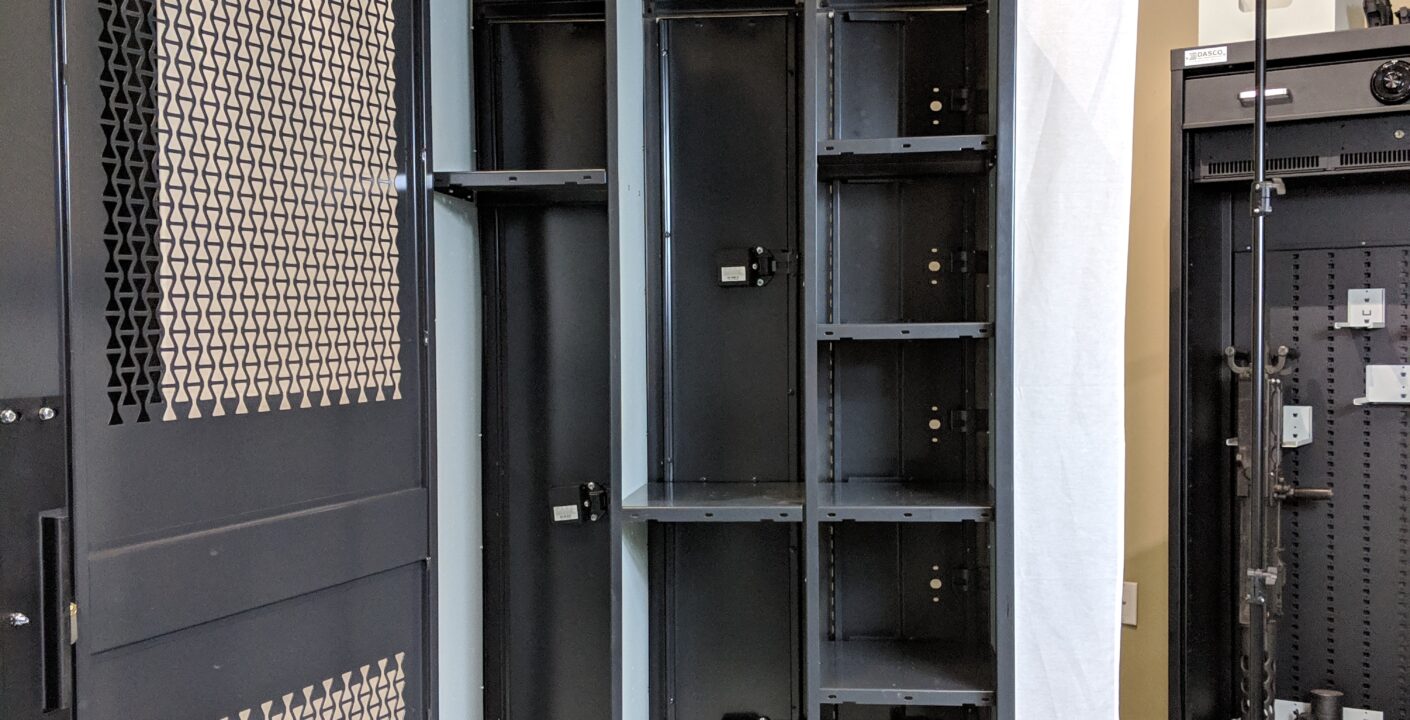
Review the full specification and documentation capabilities of DASCO law enforcement weapons storage systems as a reference for what a fully compliant system should produce against each of these audit points.
Evidence Storage Audit
Evidence storage carries the highest consequence for documentation failures because the records it produces go directly to court. Apply proportionally more scrutiny here than to any other storage category.
Physical separation. Confirm that evidence firearms are stored in a physically separate, access-controlled space from departmental weapons. The separation needs to be documentable, meaning it needs to be enforced by the storage system itself rather than by procedure. If evidence and duty weapons share the same storage room with different cabinets, verify that the access control on evidence storage is completely independent of duty weapon access and that the logs reflect that independence.
Intake documentation completeness. Pull a sample of 20 intake records from the past six months and review each for completeness: item identifier, submitting officer, receiving custodian, date and time, condition description, and case number. Any intake record missing a required field is a chain-of-custody vulnerability for that item. If a pattern of incomplete intake documentation emerges in your sample, assume it extends beyond the sample.
Transfer log audit. For every active case with evidence in storage, trace the complete transfer history of each item from intake to current location. Every handoff should be documented with both a release record and a receipt record. A release record without a corresponding receipt means an item is currently unaccounted for in your documentation, even if you know physically where it is.
Long-term storage review. Identify every item that has been in evidence storage for more than two years and confirm that disposition holds or case status documentation exists for each. Long-term storage items that lack current case documentation are an audit finding waiting to happen and a storage capacity problem that compounds over time.
Court transfer documentation. For any item currently checked out for court or lab purposes, verify that the checkout is documented with case number, receiving party, authorized personnel, and expected return date. Items that are out of storage without complete checkout documentation have an open chain-of-custody gap that exists in real time.
The audit trail generation capabilities of DASCO evidence storage systems are designed to produce documentation that satisfies each of these audit points automatically, eliminating the manual reconciliation burden that makes evidence storage audits so time-consuming in departments running legacy systems.
Ammunition Storage Audit
Ammunition storage audits fail most often on two issues: lot-level tracking and physical separation. Both are addressable before an external reviewer finds them.
Lot-level inventory. Your ammunition inventory should be recorded at the lot level, not just by caliber and quantity. Pull your current inventory record and confirm that every ammunition lot in storage has a corresponding receipt record showing when it was received and from which supplier. If your inventory records show quantities by caliber without lot attribution, you have a documentation gap that will surface during any serious audit.
Physical separation verification. Confirm that duty ammunition, training ammunition, and evidence ammunition are stored in physically separate, individually labeled spaces. Walk the storage area and look for any commingling, even informal or temporary. A box of training rounds sitting in the duty ammunition storage area during a shift is a separation failure regardless of intent.
Distribution log completeness. Pull the distribution log for the past 90 days and verify that every ammunition issue is documented with recipient, quantity, lot number, date, and purpose. Compare the documented distribution against your beginning and ending inventory records. The numbers should reconcile. If they don’t, the discrepancy needs a documented explanation before an auditor asks for one.
Rotation and expiration review. Identify any ammunition lots that have exceeded your department’s recommended service period or the manufacturer’s recommended storage life. Duty rounds that haven’t been rotated on a documented schedule are both a reliability concern and a documentation gap. If your current system has no mechanism for flagging ammunition age, that system limitation is itself worth noting as part of your audit findings.
Review how DASCO law enforcement ammunition storage solutions handle lot tracking, physical separation, and distribution logging as a benchmark for what your current system should be producing.
Gear Storage Audit
Gear storage audits focus less on chain-of-custody documentation and more on accountability, condition, and operational readiness. The questions are different from evidence and weapons storage but they’re no less important during an accreditation review.
Individual assignment verification. Confirm that every piece of departmental gear has a documented assignment to a specific officer or to a specific shared-use category. Any gear that exists outside of a clear assignment framework is unaccounted for in your inventory and unattributable if it goes missing or comes back damaged.
Condition documentation. Pull your gear inspection records for the past six months. Every item should have a documented condition assessment on a regular cycle, with any damage or serviceability issues noted and tracked to resolution. Gear that has been in service without documented inspection is a liability in any use-of-force review where equipment condition becomes relevant.
Inventory reconciliation. Compare your gear inventory record against a physical count. Pay particular attention to high-value items: plate carriers, helmets, less-lethal equipment, body cameras, and communication devices. These are the items most likely to surface as discrepancies during an external review and the ones where discrepancies raise the most questions.
Storage condition assessment. Walk the gear room and assess whether the physical storage environment is maintaining equipment in serviceable condition. Look for plate carriers stored in ways that stress the material, helmets without designated storage that protect retention system integrity, and any storage conditions that accelerate wear. Equipment degradation that results from inadequate storage is a procurement and liability issue, not just a maintenance one.
The individual assignment and condition tracking capabilities of DASCO law enforcement gear storage systems address the accountability requirements that gear storage audits focus on, with storage configurations designed to maintain equipment condition across the operational life of the asset.
Documenting Your Findings and Closing the Loop
An internal audit that produces a list of findings without a documented remediation process hasn’t reduced your risk. It has created a record of known problems without evidence of response, which in some contexts is worse than not having conducted the audit at all.
For every finding your internal audit produces, document three things: what the finding is, what action will be taken to address it, and by when. Assign ownership for each remediation item to a specific individual. Set a follow-up date to verify that remediation was completed and document that verification.
The completed audit record, including findings, remediation assignments, and verification, should be retained as a formal document. If an external reviewer subsequently identifies any of the same issues, your internal audit record demonstrates that you identified the problem, took it seriously, and addressed it. That context matters significantly in how a finding is characterized and what remediation is required.
If your internal audit identifies infrastructure gaps that procedural remediation alone can’t close, those gaps are the starting point for a storage upgrade conversation, not the end of it. A department that knows specifically what its current system can’t produce is in a much better position to specify what it needs than one that is discovering gaps for the first time during an external review. Read more practical guidance for law enforcement on the Arctos Industries blog.
Running an internal audit and finding gaps your current storage infrastructure can’t close?
We work with departments to assess what their current systems produce against the standard external reviewers apply, and help identify storage solutions that close the gaps before they become findings.
Reach out at arctosindustries.com/contact or visit arctosindustries.com to learn more.
For Law Enforcement professionals: your agency’s training officers and SOPs should guide your specific operational setup and compliance requirements. This article focuses on storage specifications and documentation practices to support internal review and purchasing decisions.