
Budget conversations in law enforcement procurement almost always come down to the same logic: get the most coverage for the least spend. That logic works for a lot of purchases. Ammunition storage is one where it tends to backfire, sometimes quietly over years, sometimes loudly all at once.
The upfront cost difference between a basic steel cabinet with a padlock and a purpose-built, access-controlled ammunition storage system is real. What’s less visible is what the cheaper option costs over time, across four categories that don’t show up on a purchase order but absolutely show up on a department’s operational and legal record.
Theft: The Risk That Scales With Access
Ammunition theft from law enforcement facilities is not a hypothetical. It happens, and it happens most frequently in departments where storage relies on shared access, minimal logging, and physical security that wasn’t designed to deter someone who knows the environment.
A basic cabinet with a combination lock shared among multiple officers creates conditions where theft is genuinely difficult to detect, let alone attribute. If ten people have the combination and a discrepancy shows up during inventory, the investigation starts with ten suspects and no usable evidence. Without individual access logging, there is no path to accountability short of a confession or a witness.
The downstream risk isn’t just the value of the stolen rounds. Law enforcement ammunition that ends up on the street carries its own liability. If seized ammunition that was stored alongside departmental stock is later connected to a crime, and your storage system can’t demonstrate physical separation and individual access control, the department is explaining that connection in a very unfavorable context.
Purpose-built storage with individual access credentials and automatic logging doesn’t eliminate the possibility of theft entirely, but it makes attribution straightforward and deterrence meaningful. The officer who knows that their credential is the one that opened the cabinet at 11pm on a Tuesday is operating under a very different accountability structure than one who shares a padlock combination with nine colleagues.
See how DASCO’s law enforcement ammunition storage systems approach access control and individual accountability for exactly this reason.
Degradation: What Happens to Rounds Nobody Is Tracking
Ammunition has environmental tolerances. Humidity, temperature cycling, and prolonged compression from improper storage all affect reliability, and reliability failures in a duty round are not a quality control inconvenience. They are a safety issue for the officer carrying the weapon.
Budget storage options frequently lack the environmental controls and physical configuration that preserve ammunition condition over time. A basic metal cabinet in an unregulated storage room offers no humidity control, no temperature stability, and often no separation between ammunition types that have different storage requirements.
The degradation problem compounds when departments lack a systematic rotation process. Rounds that were issued for duty carry and then returned, or ammunition that has been in storage through multiple seasons without assessment, can accumulate in a system that has no mechanism for flagging age or condition. Nobody is tracking lot numbers against receipt dates. Nobody is pulling rounds that have exceeded recommended service periods. The system simply holds whatever is put into it until someone runs out or someone notices a problem.
The cost of a degraded round isn’t measured in the price of the ammunition. It’s measured in what happens when an officer needs their firearm to function and it doesn’t, and in the liability exposure that follows any use-of-force incident where equipment reliability becomes a question.
Audit Failures: When the Savings Disappear in One Review
This is where the math on cheap storage becomes most obviously unfavorable, because it’s the most direct and quantifiable cost.
A department that saves three thousand dollars buying basic cabinet storage instead of a purpose-built system, and then spends forty hours of staff time preparing manual inventory reconciliations before each audit, has already lost money within the first year. Factor in the cost of a single audit finding that requires a formal remediation response, and the calculation becomes even clearer.
Auditors reviewing ammunition management are looking for specific things: lot-level inventory records, distribution logs that account for every round issued, documentation of rotation and disposal, and physical separation between duty and evidence ammunition. A basic cabinet with a sign-out sheet doesn’t generate any of these records automatically. Every one of them has to be manually compiled, and manual compilation means gaps, inconsistencies, and the kind of documentation that looks unreliable under scrutiny even when the underlying practice has been sound.
Departments that have failed ammunition-related audit findings consistently report the same experience: the remediation process costs significantly more in staff time, external review, and procedural overhaul than the storage upgrade would have cost in the first place. The savings were real at purchase. They were gone by the first serious review.
The Weapons Storage Connection
Ammunition storage and weapons storage failures tend to occur together, because they share the same root cause: storage infrastructure that wasn’t designed around accountability requirements.
Departments that upgrade their ammunition storage without addressing weapons storage often find that auditors treat the two as a single system for accountability purposes, and a strong ammunition storage setup sitting next to a weak weapons storage setup doesn’t produce a strong overall result. The gaps in one undermine the credibility of the other.
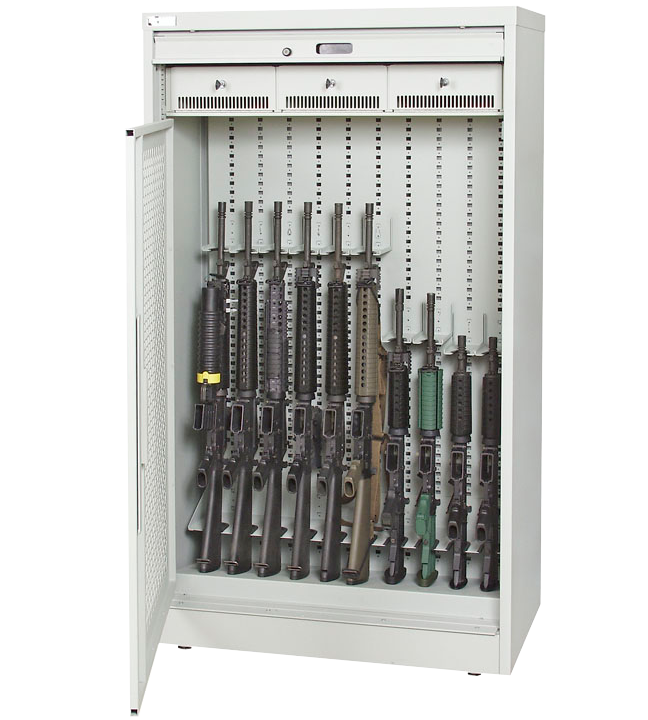
Addressing both at the same time, with systems designed to work together, produces a coherent accountability framework rather than a patchwork one. DASCO’s law enforcement weapons storage solutions are built on the same access control and audit trail principles as their ammunition storage line, so departments that standardize across both categories end up with documentation that tells a consistent story under review.
The Real Cost Calculation
Here’s how the cost-benefit analysis actually looks when you run it honestly over a five-year period.
Basic storage: lower purchase price, manual reconciliation burden at every audit, no individual access logging, no automatic distribution records, no lot tracking, no environmental controls. One audit finding or one theft investigation absorbs the savings and then some.
Purpose-built storage: higher purchase price, automatic audit trail generation, individual access accountability, lot-level tracking built into the system, environmental stability, and a documentation record that holds up under legal scrutiny. The ongoing cost is lower and the liability exposure is significantly reduced.
I’ll be honest: the upfront number on quality ammunition storage gives procurement officers pause, especially in departments where budgets are tight and competing priorities are real. But the departments I’ve seen try to manage ammunition accountability on a basic storage budget consistently end up spending more, just not all at once and not on a line item that shows up at purchase.
What does your current ammunition storage system actually cost you in staff time, audit preparation, and liability exposure? That number is worth calculating before the next procurement decision. Read more practical guidance for law enforcement on the Arctos Industries blog.
Want to run through what purpose-built ammunition storage would actually cost your department versus what your current system is costing you?
We work through that calculation with departments regularly. It’s a practical conversation and there’s no obligation on either side.
Reach out at arctosindustries.com/contact or visit arctosindustries.com to learn more.
For Law Enforcement professionals: your agency’s training officers and SOPs should guide your specific operational setup. This article focuses on storage specifications and procurement considerations to inform purchasing and compliance decisions.