
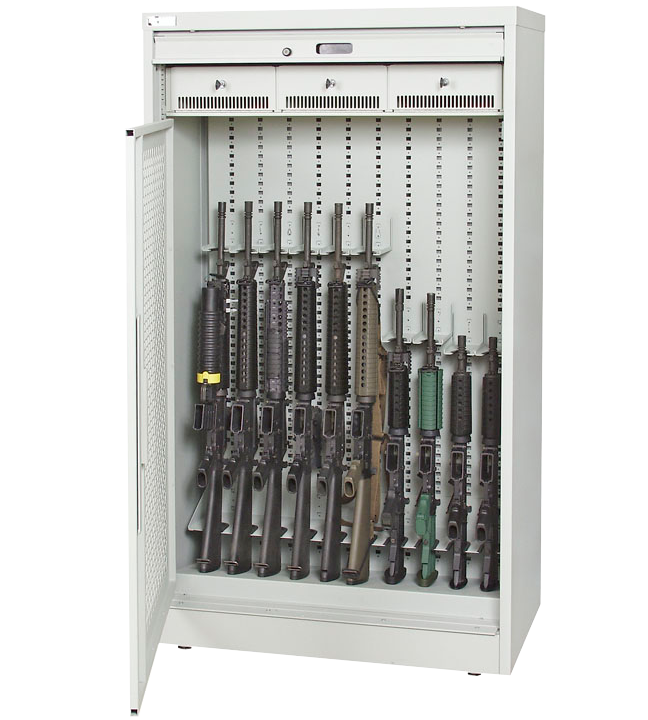
At first glance, a standard locker and a purpose-built law enforcement weapons storage unit can look like the same category of product. Both are steel. Both lock. Both hold things securely, or at least that’s the implication.
The differences between them aren’t cosmetic. They’re structural, mechanical, and operational, and they matter in ways that become very clear when you’re trying to explain to an auditor, a prosecutor, or an insurance carrier why you chose the system you did.
Here’s the honest technical breakdown.
Steel Gauge: Where It Starts
Steel gauge is the first and most fundamental difference between a standard locker and a purpose-built weapons storage system, and it’s also the specification most commonly glossed over in procurement conversations.
Standard commercial lockers typically run 16 to 24 gauge steel. The higher the gauge number, the thinner the steel. A 24-gauge locker is using steel roughly 0.6mm thick. It’s adequate for securing personal belongings in a gym or a school. It is not adequate for securing firearms in a law enforcement environment, and the reason is straightforward: thin-gauge steel yields to relatively modest forced entry attempts. A determined person with basic tools can defeat a 24-gauge locker in under two minutes.
LE-grade weapons storage starts at 14 gauge, which is approximately 1.9mm thick, and purpose-built systems often use 12 gauge or heavier for primary storage walls and door panels. That difference in material thickness translates directly to resistance against forced entry, prying, and the kind of sustained physical attack that a determined individual might apply to a storage unit containing firearms.
When evaluating any weapons storage system, ask for the gauge specification on the body, the door panel, and the door frame separately. A unit with a heavy-gauge door mounted in a light-gauge frame has a weak point that negates the strength of the door. Reputable manufacturers spec consistently across all structural components.
Locking Mechanisms: The Difference Between a Lock and a Security System
Standard lockers use one of a few basic locking mechanisms: a built-in key lock, a padlock hasp, or a combination dial. These are adequate for the threat environment they were designed for, which is unauthorized access by opportunistic individuals without tools or time.
Law enforcement weapons storage operates in a different threat environment and under different accountability requirements, and the locking system needs to reflect both.
On the physical security side, LE-grade locking mechanisms use multi-point locking bars rather than single-point latches. A single-point latch secures the door at one location. A multi-point bar extends the full height of the door and engages at three or more points simultaneously, distributing the resistance across the entire door frame rather than concentrating it at a single bolt. Defeating a multi-point system requires either defeating the lock cylinder itself or applying force simultaneously across multiple engagement points, neither of which is achievable quickly or quietly.
On the accountability side, electronic access control with individual credential assignment is where LE-grade storage separates most clearly from standard lockers. A standard locker with a key provides access to whoever has the key. An LE-grade system with electronic access control provides access to specifically authorized individuals, logs every access event with a timestamp and user identifier, and allows remote credential revocation when an officer’s status changes.
That audit trail isn’t a convenience feature. It’s the documentation that answers the accountability questions an investigation or an audit will ask. Who accessed this unit? When? How many times? A standard locker with a shared key cannot answer any of those questions.
Explore the access control specifications across the full range of DASCO law enforcement weapons storage systems to see how individual credential management and audit trail generation work in practice.
Tamper Resistance: Beyond the Lock
Tamper resistance in a purpose-built weapons storage system goes beyond the locking mechanism itself. It covers the physical design choices that prevent bypassing the lock entirely.
Concealed hinges are one of the more straightforward examples. A standard locker with exposed hinges can be defeated by removing the hinge pins, regardless of the strength of the lock. LE-grade storage systems use fully concealed or anti-removal hinges that cannot be accessed or defeated from the exterior of the unit.
Door overlap and anti-pry design address a different attack vector. Standard lockers often have minimal overlap between the door and the frame, which creates a gap that can be exploited with a pry bar. Purpose-built systems use door designs with substantial overlap and reinforced frame edges that resist prying attempts even with significant applied force.
Anchor points matter as well. A storage unit that isn’t secured to a structural element can be moved, tipped, or removed entirely. LE-grade systems include anchor provisions that allow secure attachment to walls, floors, or structural supports, and the anchor hardware is typically internal or concealed to prevent access from outside the unit.
Anti-pick and anti-drill provisions on lock cylinders are standard in LE-grade systems and essentially absent in standard lockers. Lock cylinders rated for law enforcement use include hardened steel inserts that defeat drill attacks and pin configurations that resist picking attempts significantly more effectively than standard commercial cylinders.
Modular Configuration vs. Fixed Capacity
Standard lockers are fixed units. You buy a locker, it holds a defined volume, and if your storage needs change you buy another locker that may or may not integrate with the first one in any meaningful way.
Purpose-built LE-grade weapons storage systems are designed around modular configurations that scale with operational requirements. Additional units integrate with existing installations within the same access control framework, so a department that starts with storage for 20 weapons and grows to 40 doesn’t end up managing two separate systems with two separate audit trails and two separate access control setups.
Modular configuration also allows departments to combine storage types within a single integrated system. Pistol storage, long gun storage, and tactical equipment storage can exist within the same physical footprint and the same access control framework, with different authorization levels controlling which officers can access which sections.
That flexibility matters at the specification stage because departments rarely know exactly what their storage requirements will look like three years after installation. A modular system purchased for current needs can accommodate future needs without requiring a complete replacement.
The same modular design principle applies to gear storage. DASCO’s law enforcement gear storage configurations integrate with their weapons storage line, allowing departments to build a consistent storage environment across equipment categories rather than managing a collection of mismatched systems.
The Compliance Dimension
Standard lockers don’t meet the physical security specifications required by most state law enforcement accreditation bodies for weapons storage. This isn’t a gray area in most jurisdictions. Accreditation standards specify minimum construction requirements for weapons storage, and standard commercial lockers typically fall short of those requirements on steel gauge, locking mechanism type, and anchor provisions.
Departments that discover this during an accreditation review are in a difficult position. The cost of replacing non-compliant storage under time pressure, with an active finding on record, is consistently higher than the cost of specifying compliant storage at the outset. The gap between the price of a standard locker and an LE-grade system looks different when it’s being evaluated against the cost of a failed accreditation review and a mandated remediation timeline.
Putting the Comparison in Practical Terms
Standard lockers are well-made products for the environments they were designed for. The problem isn’t that they’re poorly built. It’s that they were built to a different standard for a different threat environment and a different accountability requirement.
Putting standard lockers in a law enforcement weapons storage application is a specification mismatch, not a cost-saving measure. The savings at purchase don’t offset the compliance exposure, the liability gap, or the accountability limitations that come with the choice.
The full range of DASCO storage solutions covers the complete spectrum from individual weapons storage to department-wide integrated systems, all built to the construction and accountability standards that law enforcement environments actually require.
When was the last time your department reviewed whether your current weapons storage meets your accreditation body’s physical security specifications? It’s a straightforward question with an answer worth knowing. Read more practical guidance for law enforcement on the Arctos Industries blog.
Want to compare your current storage specifications against LE-grade requirements?
We work through that assessment with departments regularly. It’s a practical conversation that starts with what you have and works toward what you actually need.
Reach out at arctosindustries.com/contact or visit arctosindustries.com to learn more.
For Law Enforcement professionals: your agency’s training officers and SOPs should guide your specific operational setup. This article focuses on storage specifications and construction standards to inform purchasing and compliance decisions.