
Prosecutors don’t usually get involved in conversations about evidence storage infrastructure. That’s a department concern, a budget concern, a facilities concern. By the time a case reaches the DA’s office, the evidence has already been handled, stored, and documented, and whatever system produced that documentation is what the prosecutor is working with.
The problem is that prosecutors feel the consequences of storage failures more directly than almost anyone else in the process. They’re the ones standing in front of a judge when defense counsel produces a chain-of-custody gap. They’re the ones explaining to a victim’s family why a case that should have been straightforward got complicated. They’re the ones watching a conviction get overturned on appeal because the evidence documentation didn’t hold up to scrutiny.
What follows is an honest look at what bad evidence storage does to a case, written for the law enforcement side of the equation, because that’s where the storage decisions get made and where the problems originate.
The Chain-of-Custody Attack: How Defense Counsel Uses Storage Failures
Defense attorneys don’t need to prove that evidence was tampered with. They need to create reasonable doubt that it wasn’t. A storage system with gaps, inconsistencies, or documentation failures gives them the raw material to do exactly that, and experienced defense counsel is very good at making documentation problems look like integrity problems.
Here’s how it typically plays out. A firearm is central to the prosecution’s case. Defense counsel requests the complete chain-of-custody documentation. The evidence custodian produces what the system generated, which in a manual or poorly maintained setup is a partial record: an intake entry, a few transfer logs, gaps where handoffs weren’t documented, a court transfer entry. The defense doesn’t need to explain what happened during the gaps. They just need to point to them.
The prosecutor now has to argue that the evidence is reliable despite a documentation record that doesn’t fully account for its location and handling over the relevant period. That argument is possible but it’s uphill, and it hands the defense a narrative they can use throughout the trial regardless of how strong the other evidence is.
A storage system that generates a complete, timestamped, tamper-resistant audit trail from intake to courtroom doesn’t give the defense that opening. Every handoff is documented. Every access event is logged. The chain is complete and the documentation format is consistent and credible. The prosecutor walks into court with evidence that can withstand scrutiny rather than evidence that requires defending on its own merits before the substance of the case even comes up.
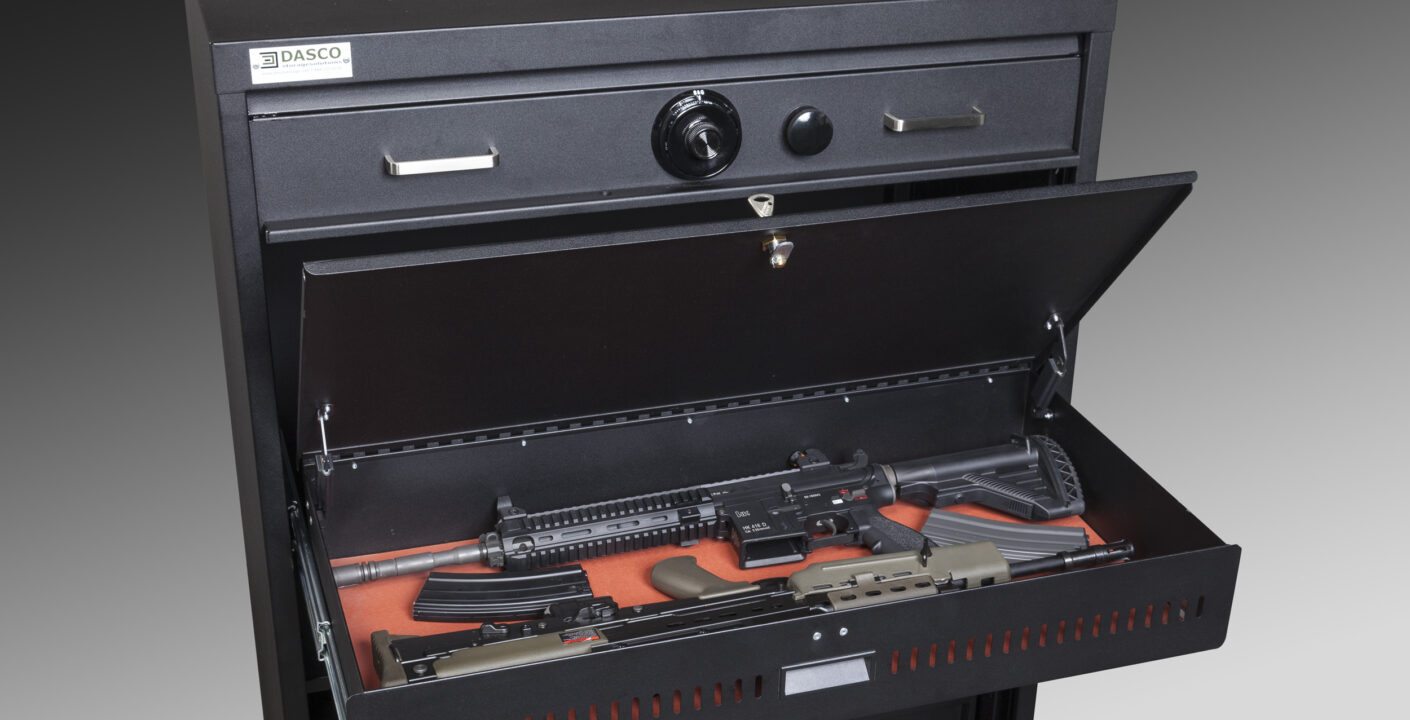
Purpose-built DASCO evidence storage systems generate exactly this kind of complete, automatic audit trail, because the chain-of-custody documentation is produced by the storage system itself rather than assembled from manual logs after the fact.
Contamination and Commingling: When the Physical Evidence Becomes Questionable
Chain-of-custody documentation is one half of the evidence integrity question. The physical condition and separation of the evidence itself is the other, and storage failures on the physical side create problems that documentation alone can’t fix.
Commingling is the scenario prosecutors dread most. Evidence firearms stored in proximity to departmental weapons without documented physical separation create a defense argument that the evidence could have been substituted, swapped, or contaminated. The argument doesn’t require proof of actual commingling. It requires only that the storage system didn’t make commingling impossible.
The same logic applies to ammunition. Seized rounds stored without documented separation from departmental ammunition stock create a chain-of-custody vulnerability that can unravel ballistic evidence. If the prosecution’s case depends on matching a projectile recovered from a scene to ammunition seized from a suspect, and the defense can argue that the evidence ammunition was stored in a way that allows for substitution or confusion, the ballistic evidence loses credibility before the expert testimony even begins.
Physical separation that is enforced by the storage system itself, rather than by procedure alone, closes that argument. When evidence firearms and departmental weapons are in physically separate, individually access-controlled storage with separate audit trails, the defense argument about possible commingling has no foundation to build on.
Dedicated law enforcement ammunition storage solutions address the separation requirement for seized rounds specifically, maintaining physical and documentary separation from departmental stock as a design feature rather than a procedural requirement that depends on consistent human compliance.
The Suppression Hearing Nobody Wants to Be In
Evidence suppression hearings are where storage failures become case-ending events rather than complications. When a defense motion argues that evidence should be suppressed due to improper handling or chain-of-custody failures, the prosecutor’s ability to respond depends entirely on the quality of the documentation the storage system produced.
A suppression hearing puts the storage system on trial before the evidence ever reaches the jury. The evidence custodian who maintained the system becomes a witness. The procedures that governed storage and handling become exhibits. The gaps, inconsistencies, and documentation failures become arguments for exclusion.
Judges grant suppression motions when they conclude that the integrity of the evidence cannot be established to the required standard. The required standard isn’t certainty. It’s reasonable assurance that the evidence presented is the evidence that was seized and that it hasn’t been materially altered. A storage system with comprehensive documentation makes that assurance straightforward to establish. A system with gaps makes it a legal argument rather than a factual demonstration.
The cases that reach suppression hearings on evidence integrity grounds rarely involve actual misconduct. They involve storage systems that were inadequate for the accountability standard required of them, operated by people who were doing their best within the constraints of what the system could produce.
Appeals and Post-Conviction Review: The Long Tail of Storage Failures
The consequences of evidence storage failures don’t necessarily end with a verdict. Post-conviction review processes and appeals on chain-of-custody grounds can reopen cases years after conviction, and the standard for what constitutes an adequate chain-of-custody record tends to become more demanding over time, not less.
A department whose storage system produced adequate documentation under 2015 standards may find that same documentation challenged under 2025 standards during an appeal. Courts have become more sophisticated about evidence integrity requirements, and the documentation that was acceptable a decade ago is increasingly subject to scrutiny that it wasn’t designed to withstand.
This is one of the less obvious arguments for upgrading evidence storage infrastructure even in departments where the current system hasn’t yet produced a visible failure. The cases being prosecuted today will be subject to appeal for years. The storage documentation being generated today is the record that will have to hold up in those future proceedings. A system that generates comprehensive, tamper-resistant, digitally authenticated records is building a foundation that will withstand that scrutiny. A manual system is generating documentation whose limitations will only become more apparent over time.
What Prosecutors Actually Want From Evidence Storage
The prosecutors who have been most vocal in conversations I’ve been part of about evidence storage infrastructure are consistent about what they want, and it’s not complicated.
They want a complete record. Every intake, every transfer, every access, every return, documented automatically and stored in a format that is searchable, printable, and defensible in court. They don’t want to receive a case file and spend time reconstructing a chain of custody from partial manual records. They want to receive a case file with a chain-of-custody report attached that accounts for the evidence from seizure to courtroom without gaps.
They want physical separation that is provable. Not separation that depends on a procedure that someone may or may not have followed consistently, but separation that the storage system enforces and documents independently of human behavior.
And they want to know that when they call the evidence custodian before a trial and ask about the condition and location of a specific item, the answer comes from a system record rather than a recollection. Recollections get challenged. System records get authenticated.
None of that is an unreasonable ask. It’s what purpose-built evidence storage infrastructure is designed to deliver, and it’s the standard that the departments whose cases hold up in court are consistently meeting. Read more practical guidance for law enforcement on the Arctos Industries blog.
Want to evaluate whether your current evidence storage system produces the documentation standard that modern prosecutions require?
We work with departments to assess what their current system generates and where the gaps are before those gaps become a problem in court.
Reach out at arctosindustries.com/contact or visit arctosindustries.com to learn more.
For Law Enforcement professionals: your agency’s training officers and SOPs should guide your specific operational setup. This article focuses on storage specifications and evidence management considerations to inform purchasing and compliance decisions.