
By Duncan Horner, CEO — Arctos Industries
For Law Enforcement and Military professionals: your agency’s training officers, unit SOPs, and chain of command should guide your specific gear configuration and operational employment. This article focuses on equipment specifications and material considerations to inform gear selection decisions.
The tactical gear market is not short on plate carriers. Every brand has one. Most of them look similar in product photos, use similar terminology, and make similar claims about durability and modularity. The differences that matter to an operator who depends on their gear under pressure aren’t visible in a product photo, and they don’t show up in marketing language. They show up in how the carrier behaves after a thousand reps, after a soaking, after a hard deployment, and in how it performs when the configuration needs to change on short notice.
HRT Tactical has built a reputation in professional circles that doesn’t come from marketing spend. It comes from operators who have used the gear under conditions that expose the difference between a carrier that was engineered and one that was assembled. Here’s what that difference actually looks like at the material and construction level.
Material Specification: Why 500D Cordura Is the Starting Point, Not the Selling Point
500 denier Cordura is the baseline fabric specification for HRT carriers and LBE, and it’s worth being precise about what that means and what it doesn’t. 500D Cordura is a nylon fabric with a specific yarn size and weave density that produces a consistent balance of abrasion resistance, tear strength, and weight. It’s the material specification that serious tactical manufacturers converge on because it holds up under operational use without adding unnecessary weight to a system that’s already carrying plates, ammunition, and medical equipment.
The distinction that matters isn’t the fabric name. It’s the consistency of the specification. Cordura is a brand name, not a regulatory standard, and manufacturers who specify “Cordura-like” or “high-denier nylon” without referencing the actual Cordura specification may be using fabric that approximates the material properties without meeting them. HRT uses genuine Cordura throughout the carrier and LBE line, which means the abrasion and tear resistance characteristics are consistent and verifiable rather than approximate.
Fabric weight consistency across production runs matters for team standardization. A carrier built to a consistent material specification performs consistently regardless of when it was manufactured. A carrier built to a “close enough” specification may vary between production batches in ways that become apparent under sustained use, which creates maintenance and replacement inconsistencies across a team that was supposedly standardized on the same gear.
Stitching: Where Construction Quality Becomes Functional Reliability
Stitching is the construction element that most buyers don’t examine closely enough and that experienced operators evaluate first. The stitching on a plate carrier isn’t primarily aesthetic. It’s structural, and the stitch type, thread weight, stitch density, and reinforcement at high-load points determine whether the carrier maintains its structural integrity under the dynamic loads of operational use or whether it starts to fail at attachment points and seams after sustained use.
HRT uses 11-ounce bonded nylon thread across the carrier line, which is the thread weight that provides adequate tensile strength for load-bearing seams without creating bulk that compromises the stitching density. Bonded thread resists the moisture degradation that causes standard thread to weaken over time in environments with repeated exposure to sweat, rain, and water crossings. A carrier that spent its first year in a temperate environment and then gets deployed to a wet environment will stress-test the thread bonding in ways that most users don’t anticipate.
Stitch density at load points is where HRT’s construction diverges most visibly from lower-specification alternatives. The attachment points for cummerbunds, the MOLLE rows, the drag handle if present, and the shoulder strap junctions are the points where carrier failure initiates when it happens. HRT reinforces these points with bar-tack stitching, which is a high-density stitch pattern specifically designed to distribute load across a wider area of fabric rather than concentrating it at a single point. A bar-tack that’s correctly specified for the load it’s carrying looks like a minor construction detail in a product photo and becomes the difference between a carrier that holds together under a casualty drag and one that doesn’t.
MOLLE Construction: The Specification That Determines Accessory Compatibility
MOLLE webbing compatibility is one of the most consistently misrepresented specifications in the tactical gear market. MOLLE, which stands for Modular Lightweight Load-carrying Equipment, is a webbing attachment system with specific dimensional requirements: 1-inch webbing, 1.5-inch spacing between rows, and webbing positioned to allow the interlocking attachment that makes MOLLE pouches removable and repositionable. Those dimensional requirements are the standard. Meeting them is not universal among manufacturers who use the MOLLE name.
Webbing that’s close to the dimensional standard but not precisely at it produces attachment compatibility problems that operators discover when they try to attach pouches from different manufacturers or when they try to use the carrier with issued pouches that were designed to the actual standard. A pouch that should attach in one row of MOLLE movement takes three rows because the spacing is off. A pouch that should sit flush against the carrier surface sits proud because the webbing height is slightly different from what the pouch attachment was designed for. These are minor inconveniences in a static configuration and real operational problems when a configuration needs to change quickly.
HRT’s MOLLE webbing meets the dimensional standard consistently, which means the carrier is compatible with the full range of MOLLE-compatible accessories from across the market rather than only with HRT’s own pouches. That compatibility matters for operators who have existing MOLLE pouches they’re satisfied with, for units that issue specific MOLLE pouches that operators are required to run, and for anyone who wants the flexibility to configure their carrier with the best available accessory for each position rather than being locked into a single brand’s pouch selection.
The full HRT carrier and LBE range is built to dimensional MOLLE compliance throughout, with webbing specifications confirmed against the standard rather than approximated from it.
Modularity: How the Placard System Changes the Carrier’s Operational Value
Modularity in tactical gear is a word that gets used to describe almost any product with MOLLE webbing. What HRT’s carrier modularity actually means in practice is more specific than that and more operationally significant.
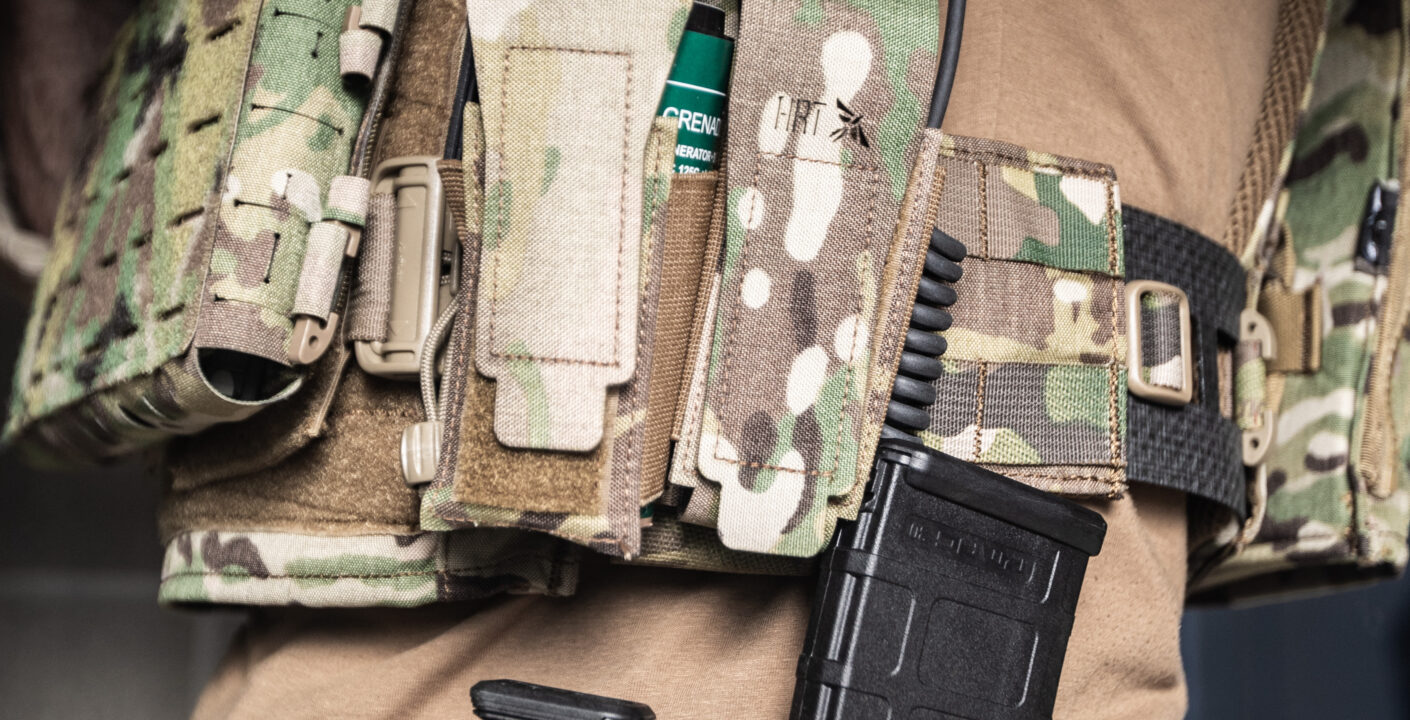
The placard-compatible front panel system on HRT carriers allows the entire front panel configuration to be swapped as a unit rather than requiring individual pouch reconfiguration. An operator who needs to change from a rifle-heavy entry configuration to a lighter patrol configuration doesn’t remove and reattach individual pouches on the carrier. They swap the placard, which carries the full configuration as a unit, and the carrier presents a completely different front panel in the time it takes to detach and reattach two points.
The operational implications of that modularity extend beyond individual operators. A unit that issues carriers with a placard set covering the configurations their operators need has essentially purchased mission-specific front panels rather than mission-specific carriers. The carrier is a shared investment that serves multiple roles. The placards carry the mission-specific configuration cost, which is significantly lower per unit than a separate carrier for each role.
Placard compatibility also means that configuration improvements can be adopted incrementally. A unit that wants to add a new front panel configuration for a new mission type purchases the relevant placard rather than replacing the carrier. The investment in the carrier base is preserved while the mission capability evolves.
The HRT placard lineup covers the pre-configured and blank platform options that support this modularity across the carrier range.
Sizing and Fit: Where Carrier Performance Meets Carrier Wearability
A carrier that performs well on a range but fits poorly over a patrol shift or a training day creates a compliance problem that no construction specification can fix. Operators who are uncomfortable in their carriers find ways to wear them incorrectly, adjust them out of the intended fit range, or leave them in the vehicle when they’re not operationally mandatory. The best-constructed carrier in the world doesn’t protect an operator who’s left it behind.
HRT carriers are sized to accommodate the plate sizes and body profiles that law enforcement and military operators actually present, with cummerbund systems that adjust through a realistic range rather than a nominal one. The difference between a carrier that fits a medium build and a carrier that fits a medium build plus body armor plates plus the incidental bulk that comes from wearing the carrier over different uniform configurations in different seasons is a sizing and adjustment range question that matters in real use.
The shoulder strap adjustment system on HRT carriers allows the carrier to be positioned correctly on the torso regardless of torso length, which is the fit parameter that most affects comfort under sustained wear. A carrier that sits too high or too low on the torso regardless of how the shoulder straps are adjusted creates pressure point issues and restricted movement that degrade performance over a shift. HRT’s adjustment range is designed around the actual distribution of torso lengths in their operator customer base rather than around a notional average.
Durability Under Operational Conditions: What the Specifications Produce in Practice
Material and construction specifications are inputs. Durability under operational conditions is the output, and it’s worth being specific about what the HRT specification produces in practice rather than leaving the connection implicit.
The 500D Cordura construction handles abrasion from vehicle interiors, concrete, and rough terrain without the surface degradation that lighter fabrics show after sustained use in those environments. The bonded thread construction maintains structural integrity through repeated moisture cycling, which is the failure mode that eliminates carriers from service most often in environments where the gear gets wet and dries repeatedly over its service life. The bar-tacked reinforcement at load points survives the dynamic loads of casualty drags, fast-roping, and the general physical stress of entries and vehicle operations without initiating the seam failures that end carriers’ operational life early.
The combination of these specifications produces a carrier that doesn’t require the same replacement cycle as lower-specification alternatives. That matters for individual operators who are investing in personal gear and for agencies and units making procurement decisions where the per-year cost of a higher-specification carrier that lasts significantly longer may be lower than the per-year cost of a lower-specification carrier that requires more frequent replacement.
The full HRT Tactical range at Arctos Industries is available with the technical specification documentation that professional procurement decisions require. Read more gear selection and configuration guidance on the Arctos Industries blog.
Want to evaluate whether HRT carriers and LBE meet the material and construction requirements for your agency’s or unit’s operational environment?
We work with law enforcement agencies and military units through gear selection decisions, with technical specification support that goes beyond what product listings provide.
Reach out at arctosindustries.com/contact or visit arctosindustries.com to learn more.
For Law Enforcement and Military professionals: your agency’s training officers, unit SOPs, and chain of command should guide your specific gear configuration and operational employment. This article focuses on equipment specifications and material considerations to inform gear selection decisions.