
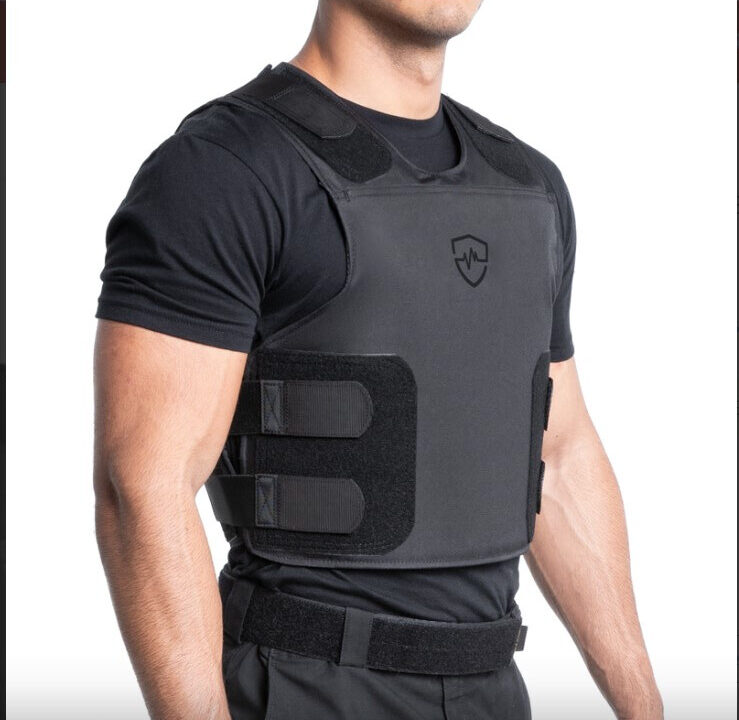
There’s a misconception that quietly circulates among new officers, security professionals, and civilians who’ve invested in body armor, and it goes something like this: if my vest stops a bullet, it’ll handle a knife. It’s a logical assumption on the surface. The armor is tough, the material is engineered, and the marketing tends to use language like “ballistic protection” in ways that imply broader coverage than actually exists.
The reality is different, and in certain environments, understanding that difference is genuinely life-critical.
For Law Enforcement and Military professionals: your agency’s training officers and SOPs should guide your specific setup and employment. This article focuses on gear specifications and considerations to inform purchasing decisions.
Two Different Engineering Problems
Ballistic armor and stab-resistant armor are not the same product. They are not even built on the same principles. A vest rated to NIJ Level IIIA, which provides solid protection against a broad range of handgun calibers, may offer you very little meaningful resistance against a knife strike. That’s not a flaw or a design compromise. It’s simply a reflection of what each product was built to solve.
Ballistic materials like woven Kevlar or UHMWPE (ultra-high-molecular-weight polyethylene) work by catching and rapidly decelerating a high-velocity projectile. The fiber network distributes the energy of the round across a wide area before it can penetrate. The mechanism depends on velocity, on the round deforming or being caught by the weave, and on the energy dispersion across the panel.
A knife operates on an entirely different principle. It’s a slow, focused, pressure-driven threat. Rather than being stopped by the fiber network, a blade can simply part the fibers, slipping between them under sustained pressure. The same property that makes Kevlar excellent at catching a fast-moving round can work against it when faced with a slow, sharp edge pushing directly into the weave.
This is not a fringe issue. Studies and real-world incidents have confirmed that standard NIJ ballistic-rated soft armor can be penetrated by an ordinary knife with a direct, sustained thrust. Understanding this is the foundation for making any informed armor decision in an environment where bladed threats are realistic.
The Standard That Actually Covers This
The NIJ has a separate certification standard for stab resistance: NIJ Standard 0115.00. It defines three protection levels, each tested against two threat categories.
Edge Blade Threats represent conventional knife attacks. Think folding knives, fixed blades, kitchen knives, improvised weapons made from sharpened materials.
Spike Threats represent pointed, narrow implements with no cutting edge. Ice picks, sharpened screwdrivers, needles, improvised shanks made from hard, narrow materials. These require a different resistance mechanism than edge blades, and a product certified against edge blades is not automatically certified against spikes.
The three protection levels under 0115.00 are:
- Level 1: Lower energy impacts, suitable for environments with limited or lower-force knife threat
- Level 2: Moderate energy, the most common certification level for law enforcement soft armor
- Level 3: Higher energy impacts, for environments where higher force attacks are a realistic concern
Each level is tested for both blade and spike threats independently. A vest marketed as “stab resistant” should specify which threat categories it’s certified against, and that documentation should be verifiable, not just a marketing claim on a product page.
When evaluating body armor for any environment where bladed threats are part of the risk profile, the first question to ask any supplier is: does this carry NIJ 0115.00 certification, at what level, and against which threat categories?
Where This Matters Most
Not every officer or security professional faces equal knife risk, and the decision of whether to invest in multi-threat or stab-specific protection should be driven by an honest assessment of actual threat environment, not worst-case assumptions or marketing defaults.
Correctional officers, detention staff, and security professionals working in environments with known weapon fabrication (improvised shanks, sharpened plastics, spike threats) face a meaningfully different threat profile than patrol officers whose primary armor justification is firearm protection. At Arctos, we see departments in corrections and detention upgrading or supplementing their armor specifically because their environment presents far more day-to-day bladed risk than ballistic risk.
Patrol law enforcement operates in a mixed-threat environment. In many cases, the threat assessment supports a multi-threat vest that covers both ballistic and stab, while adding manageable weight to what officers carry across a full shift. That trade-off is worth evaluating with the actual threat data for the specific jurisdiction in mind.
For civilian users, the threat calculus is again different. A responsible civilian who has made a considered decision to wear soft armor for personal protection in a high-risk environment may want to evaluate whether their actual risk profile includes close-contact scenarios where a bladed threat is more likely than a firearm. That honest self-assessment is what should drive the specification decision, not the product that happens to be most prominently marketed.
What Rifle Plates Actually Offer Against Bladed Threats
This is a point that often gets overlooked in conversations about knife resistance, and it’s worth being direct about it.
Hard plates, the ceramic, UHMWPE composite, or steel panels used in plate carriers for rifle protection, do provide meaningful resistance to slashing and stabbing on the areas they cover. A hard surface doesn’t have the fiber-parting vulnerability of soft woven ballistic materials. A knife blade driven against a ceramic or polyethylene composite plate is going to lose that exchange.
This is not a substitute for purpose-built stab protection, and it doesn’t address the large areas of the torso not covered by a plate. But for personnel already wearing plate carriers in higher-risk operational environments, the hard plate coverage incidentally addresses a portion of the bladed threat profile that their soft armor component might not.
The construction and testing behind modern hard plates is covered in more depth through TAP Ballistics, which is worth reviewing if you’re evaluating plate specifications alongside soft armor choices for a mixed-threat environment.
Multi-Threat Armor: What to Actually Look For
Multi-threat vests are designed to address both ballistic and stab resistance within a single panel or carrier system. They exist, they work, and for the right environment they represent the cleanest solution. The practical trade-offs are worth understanding before purchasing.
The first consideration is weight. Achieving meaningful stab resistance typically involves a tighter weave, additional layers, chainmail inserts, or a laminated panel structure. Any of those additions adds weight. A typical Level IIIA soft armor vest weighs between 1.2 and 2 pounds per panel. A multi-threat vest covering both Level IIIA ballistic and NIJ 0115.00 Level 2 stab protection will often run heavier, sometimes meaningfully so depending on construction method.
The second consideration is panel flexibility and concealability. Stab-resistant layering can reduce the flexibility of a soft armor panel, which matters for covert carriers worn under uniform. Departments evaluating covert multi-threat armor for plainclothes or undercover officers should request samples for practical fit and comfort testing before any volume purchase.
The third is certification documentation. Multi-threat vests should carry independent third-party certification for both their ballistic rating and their stab resistance rating. These are separate test protocols, and a vest that has only been internally tested to one of them while marketing both should be treated with appropriate skepticism.
A Framework for Matching Armor to Environment
Rather than defaulting to whatever the market offers most prominently, the more useful approach is to start with environment and work backward to specification.
- Corrections and detention: Stab and spike resistance should likely be a primary specification requirement. Ballistic protection may be secondary or supplemental depending on facility policy and jurisdiction.
- Patrol law enforcement: Multi-threat soft armor covering NIJ IIIA ballistic and NIJ 0115.00 Level 2 stab is typically a reasonable baseline to evaluate. Specific threat data for the jurisdiction may shift this.
- Security and civilian: An honest assessment of whether the dominant threat is ballistic, bladed, or mixed. For most environments, if a bladed threat is realistic, stab certification matters.
- Plate carrier environments: Hard plate coverage provides incidental stab resistance for covered areas. The soft armor components in the same system may still need stab evaluation depending on the role.
The Practical Summary
A standard NIJ ballistic-rated vest does not reliably protect against knife attacks, and treating it as though it does is a dangerous assumption. Stab protection requires different materials, a different construction approach, and its own certification standard under NIJ 0115.00. Multi-threat armor exists and is the practical solution for environments where both threats are real. The decision about which specification to pursue should be driven by an honest evaluation of the actual threat environment, not by the armor that happens to be most convenient to purchase.
If you’re evaluating armor options for an environment where bladed threats are part of the picture, and you want a straightforward conversation about specifications, certification, and what makes sense for your specific use case, the team at Arctos is available to help work through it.
What’s the primary environment you’re sourcing for? That usually shapes the specification conversation significantly.