
By Duncan Horner, CEO — Arctos Industries
For Law Enforcement and Military professionals: your agency’s training officers, unit SOPs, and chain of command should guide your specific gear configuration and operational employment. This article focuses on equipment specifications and setup considerations to inform gear selection decisions.
Magazine pouches are one of those gear decisions that most operators make quickly and revisit slowly. They’re not the exciting purchase. They don’t have the profile of a carrier or a weapon light. They get selected based on what looks compatible with the rest of the kit, or what a trusted colleague runs, or what happened to be in stock at the right moment.
Then training starts, and the pouch that seemed fine during a slow deliberate reload at a bench becomes a problem during a stress inoculation drill when the hands are shaking and the draw needs to happen without looking. At that point the pouch decision matters in a way that the purchase decision didn’t reflect.
Here’s what that decision actually involves.
Retention Levels: Understanding What You’re Actually Choosing Between
Retention in a magazine pouch refers to how much resistance the pouch applies to the magazine during extraction. That resistance serves two competing purposes: it keeps the magazine in the pouch during movement, vehicle operations, and physical activity, and it slows the extraction during a reload. Every retention decision is a trade-off between those two purposes, and the right trade-off depends on the operational context rather than a universal preference.
Open-top pouches with no active retention mechanism offer the fastest extraction. The magazine seats by friction or by a passive bungee retention that yields immediately to an extraction grip. The access speed advantage is real and measurable across repetitions. The security trade-off is equally real: a magazine in an open-top pouch with no active retention can be lost during a hard fall, a vehicle roll, or any physical contact that applies lateral force to the pouch opening. For operators in controlled environments where magazine loss is an acceptable risk in exchange for maximum reload speed, open-top is a reasonable choice. For operators in environments where every magazine counts and loss is not acceptable, it’s a trade-off worth examining carefully.
Retention-flap pouches add an active retention mechanism that requires a deliberate action to defeat before extraction. That action adds time to the reload but provides security that open-top pouches don’t. The retention mechanism design determines how much time it adds and how consistently it can be defeated under stress. A retention flap that requires a precise two-finger motion to release will be defeated inconsistently under stress regardless of how many times it’s rehearsed in a comfortable environment. A retention mechanism that can be defeated with a gross motor action, a palm strike or a thumb sweep, will be defeated consistently under stress because gross motor skills are more stress-resistant than fine motor skills.
Hybrid retention systems, which use a passive retention element like bungee or friction combined with a secondary retention option, offer a middle position that some operators find satisfies both the speed and security requirements for their specific context. The key word is specific. A hybrid system that works well for one operator’s role and physical environment may be the wrong trade-off for another’s.
Draw Speed: What Actually Determines It
Draw speed from a magazine pouch under stress is determined by three factors, and retention level is only one of them. The other two are indexing consistency and grip geometry, and they matter as much as retention level in determining how fast and how reliably a reload happens when it needs to.
Indexing consistency means the magazine is in the same position, at the same height, with the same orientation every time the hand reaches for it. A pouch that holds the magazine at a consistent height and angle produces a consistent reach and grip. A pouch where the magazine can sit at different depths or rotate in the pouch produces a reach that sometimes finds the grip and sometimes finds the body of the magazine, which adds a corrective step to the reload that shouldn’t be there.
HRT pouches are designed with magazine indexing as a primary functional requirement, with retention systems that hold the magazine at a consistent height and orientation rather than just preventing it from falling out. That distinction is the difference between a pouch that’s easy to reload from on a square range and one that’s easy to reload from when the conditions aren’t ideal.
Grip geometry refers to how much of the magazine base or body is accessible for the initial extraction grip. A pouch that covers the magazine base completely requires the operator to grip the magazine body rather than the base, which is a less secure grip on a smoother surface. A pouch that leaves the magazine base partially exposed allows a more secure grip for the initial extraction pull. That difference is small during a slow rehearsal and significant during a fast reload under stress when grip quality degrades with everything else.
Placement Under Stress: Where the Pouch Position Gets Tested
Pouch placement on the carrier or belt determines the reach geometry for every reload, and the reach geometry that feels natural during a slow deliberate reload in a static position may not be the same geometry that’s accessible during a reload in a compromised position, behind cover, on the ground, or during movement.
The standard guidance for carrier-mounted rifle magazine pouches is front panel mounting at a height and position that allows the support hand to index the pouch without significant body movement. What that means in practice depends on the operator’s torso length, arm length, and the carrier’s specific front panel geometry. The standard position is a starting point for confirmation through repetitions, not a final answer that applies uniformly.
Testing pouch placement under stress conditions means reloading from the pouch while kneeling, prone, and behind lateral cover, not just standing. A pouch position that’s optimal for a standing reload may require a different arm path when the body is in a different position, and discovering that mismatch during training is significantly less consequential than discovering it operationally.
The HRT first line gear range covers belt-mounted magazine pouches with the retention and indexing specifications described here, designed for consistent access across the positions and conditions that operational reloads actually happen in.
Carrier Pouches vs. Belt Pouches: What Goes Where
The decision about which magazines live on the carrier and which live on the belt is a configuration decision that most operators make by default rather than deliberately, and the default tends to load the carrier with everything and leave the belt as secondary storage. That default produces a loadout where the heaviest items are highest on the body, where the carrier becomes increasingly slow to don and doff as weight increases, and where the belt system isn’t contributing to the loadout’s functional performance in the way it could.
A more deliberate approach positions the magazines you’ll reload from first on the belt, where access is faster and where the reload doesn’t require working around the carrier’s front panel geometry. Subsequent magazines live on the carrier front panel, staged for the longer engagement scenarios where the belt magazines have been used and a deeper reload is required. That positioning makes the most accessible storage the most used storage and keeps the belt system actively contributing to performance rather than serving as overflow.
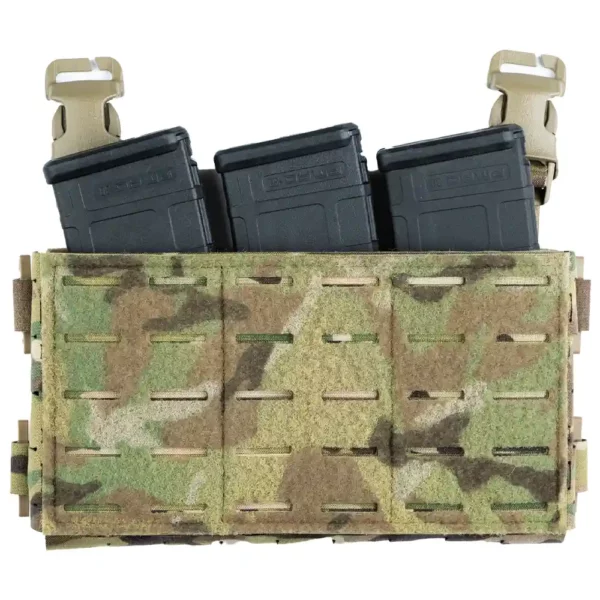
For operators running HRT carriers with placard-configured front panels, the placard system makes this distribution deliberate rather than accidental. The placard carries the carrier-mounted magazine pouches as a configured unit, and the belt carries the primary reload magazines independently. When the mission profile changes, the placard can be swapped without changing the belt configuration, and the belt configuration can be adjusted without affecting the carrier setup.
The HRT placard range covers front panel configurations with magazine pouch arrangements designed around the carrier-as-secondary-storage approach, leaving the primary reload magazines on the belt where access is fastest.
What Most Operators Get Wrong
The consistent errors in magazine pouch selection and placement come up frequently enough to name directly.
Selecting retention level for the static environment rather than the dynamic one. A pouch that feels perfectly retained during a slow walkthrough of a range will feel over-retained during a stress drill and under-retained during vehicle operations. Select retention for the most demanding environment you’ll operate in, not the most comfortable one you’ll train in.
Confirming placement only in the dominant position. Test every pouch position from kneeling, prone, and behind lateral cover before finalizing it. The position that works standing may not work in every position the role demands.
Prioritizing pouch aesthetics over indexing consistency. A pouch that looks clean on the carrier and doesn’t hold the magazine at a consistent height for a consistent grip is worse than a less visually clean pouch that indexes reliably. Function before form, every time.
Mixing pouch types with different retention levels across the same configuration. Running open-top pouches on the belt and retention-flap pouches on the carrier creates a reload process where the muscle memory for one retention type interferes with the other under stress. Consistent retention levels across the configuration produce more reliable performance than mixed retention optimized for each individual position.
The HRT carrier and LBE range is designed to work with HRT pouches as an integrated system, with MOLLE compliance and mounting geometry that produces consistent pouch positioning across every configuration. Read more gear selection and configuration guidance on the Arctos Industries blog.
Want help selecting the right magazine pouch configuration for your specific role and operational environment?
We work with operators and agency buyers through pouch selection and placement decisions, with practical guidance built around how the gear performs under actual use conditions.
Reach out at arctosindustries.com/contact or visit arctosindustries.com to learn more.
For Law Enforcement and Military professionals: your agency’s training officers, unit SOPs, and chain of command should guide your specific gear configuration and operational employment. This article focuses on equipment specifications and setup considerations to inform gear selection decisions.